Weekly RWA Roundup: Tokenized Stocks Expand Into Lending, Margin and More
Market & Insights
October 3, 2026
Tokenized stocks took another step beyond trading this week. Lending markets, exchange margin, tokenized funds, portfolio products and institutional platforms are giving these assets more utility, while regulators continue to define the rules around them. Across Solana and the wider RWA market, the focus is increasingly shifting from putting assets onchain to making them useful there.

The tokenized asset market had another busy week.
From September 27 to October 3, tokenized stocks continued expanding across trading, lending, margin and portfolio products, while regulators in the US, Europe and Asia moved closer to defining how tokenized securities should operate within traditional financial markets.
The week also brought more evidence that the next stage of the tokenized securities market is not only about putting stocks and funds onchain. It is about what those assets can do once they are there.
Tokenized funds are becoming collateral. Tokenized stocks are entering lending markets. Exchanges are adding tokenized assets to margin systems. Portfolio managers are packaging multiple assets into onchain products. At the same time, regulators are asking harder questions around custody, redemption, investor rights and settlement.
For Solana, the week brought more tokenized stock activity, new RWA infrastructure, additional tokenized assets and another major dollar asset entering the ecosystem.
But as the market grows, so do the questions around demand, liquidity and utility.
 The SEC’s tokenized securities framework enters a new stage
The SEC’s Innovation Exemption continued to attract industry feedback this week.
Six comments were added to the SEC’s public comment file between September 27 and October 1. Two of them were substantive. (SEC comment file 4-927, updated October 1, 2026)
Alex Kouam of Aethon Credit Intelligence asked the SEC to require each Tokenized Securities Venue notice to identify who verified holder rights, when that verification happened and whether the verifier was independent.
He also asked venues to disclose the redemption route for tokenized securities and the terms of any paired stablecoin or tokenized money fund.
Daniel Lau of Stove Finance asked the SEC to bring broker-dealers, transfer agents and DTC together for interoperability pilots.
The underlying SEC order sets different limits for the two tiers of Tokenized Securities Venues. Tier 1 allows up to 75 symbols with a volume cap of 0.25% of prior-month average daily volume. Tier 2 allows up to 250 symbols with a 2.5% cap. (SEC Release 34-106402, September 17, 2026)
No venue publicly announced a Tokenized Securities Venue notice during the week. The SEC order requires venues to publish those notices on their own websites rather than through an SEC register, so the absence of a public announcement is not proof that none exist.
What stands out is where the conversation is going.
The debate is moving beyond whether tokenized securities should exist. It is increasingly about how ownership is verified, how assets are redeemed and how tokenized securities connect to the existing financial system.
That same focus on market structure appeared again later in the week when the SEC proposed new custody rules explicitly covering tokenized securities.
The SEC also puts tokenized securities into its custody proposal
On October 1, the SEC proposed new custody rules for advisers and funds.
The proposal defines crypto assets broadly enough to include digital securities, commonly known as tokenized securities. It also asks what additional custody guidance may be necessary specifically for tokenized securities. (SEC press release 2026-100 and Release IA-7023, October 1, 2026)
The proposal covers custody structures including adviser self-custody and state trust companies.
The comment period will run for 60 days after publication in the Federal Register.
This matters because tokenized equities are increasingly being discussed as assets that can sit inside financial products, lending markets and investment portfolios. As adoption grows, questions around where those assets are held and how they are protected become increasingly important. How the final rules treat tokenized equities is still an open question.
The SEC also issued a statement on Commissioner Hester Peirce’s departure. Chairman Atkins and Commissioner Uyeda credited her leadership of the Crypto Task Force. Peirce announced her departure on September 25 and left on October 2. No successor as Task Force lead has been named in the SEC statements published so far. (SEC statement, October 1, 2026; departure dates per Cryptonomist, September 25, and Cryptonews, September 29)
Europe and Korea are working on their own tokenized securities frameworks
The regulatory movement was not limited to the United States.
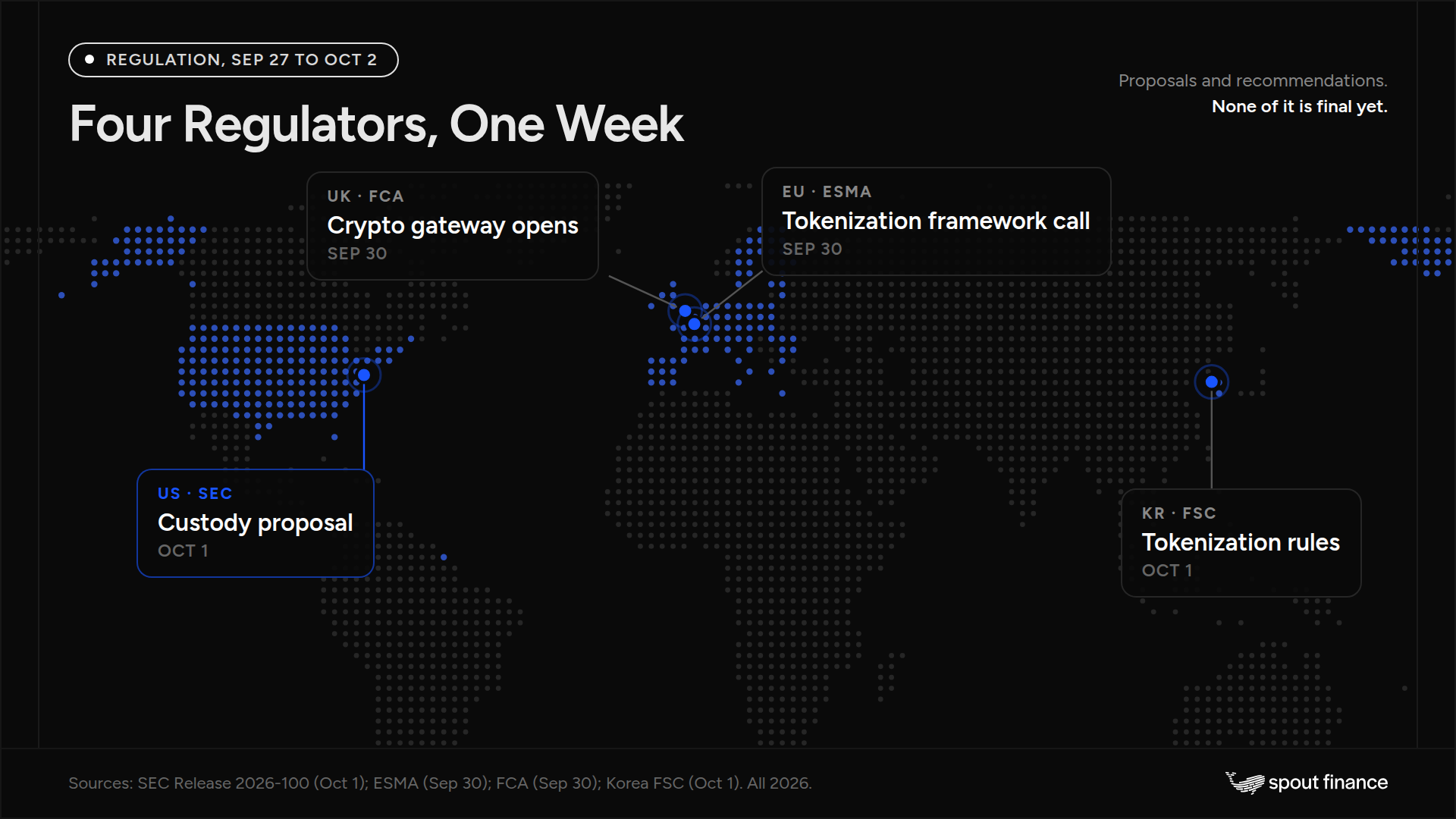
On September 30, ESMA responded to the European Commission’s MiCA review with a recommendation for a framework covering tokenized securities and onchain settlement. (ESMA, September 30, 2026)
ESMA also called for a new regulated category for firms providing access to DeFi, binding ESMA opinions on token classification and proportionate requirements for staking, lending and borrowing.
These are recommendations, not laws.
The UK also opened its crypto authorization gateway on September 30. Applications close February 28, 2027, and the regime is scheduled to begin on October 25, 2027. The FCA’s announcement does not specifically address tokenized securities, so whether particular tokenized assets or lending activities fall inside the UK’s regulatory perimeter remains an open question. (FCA press release, September 30, 2026)
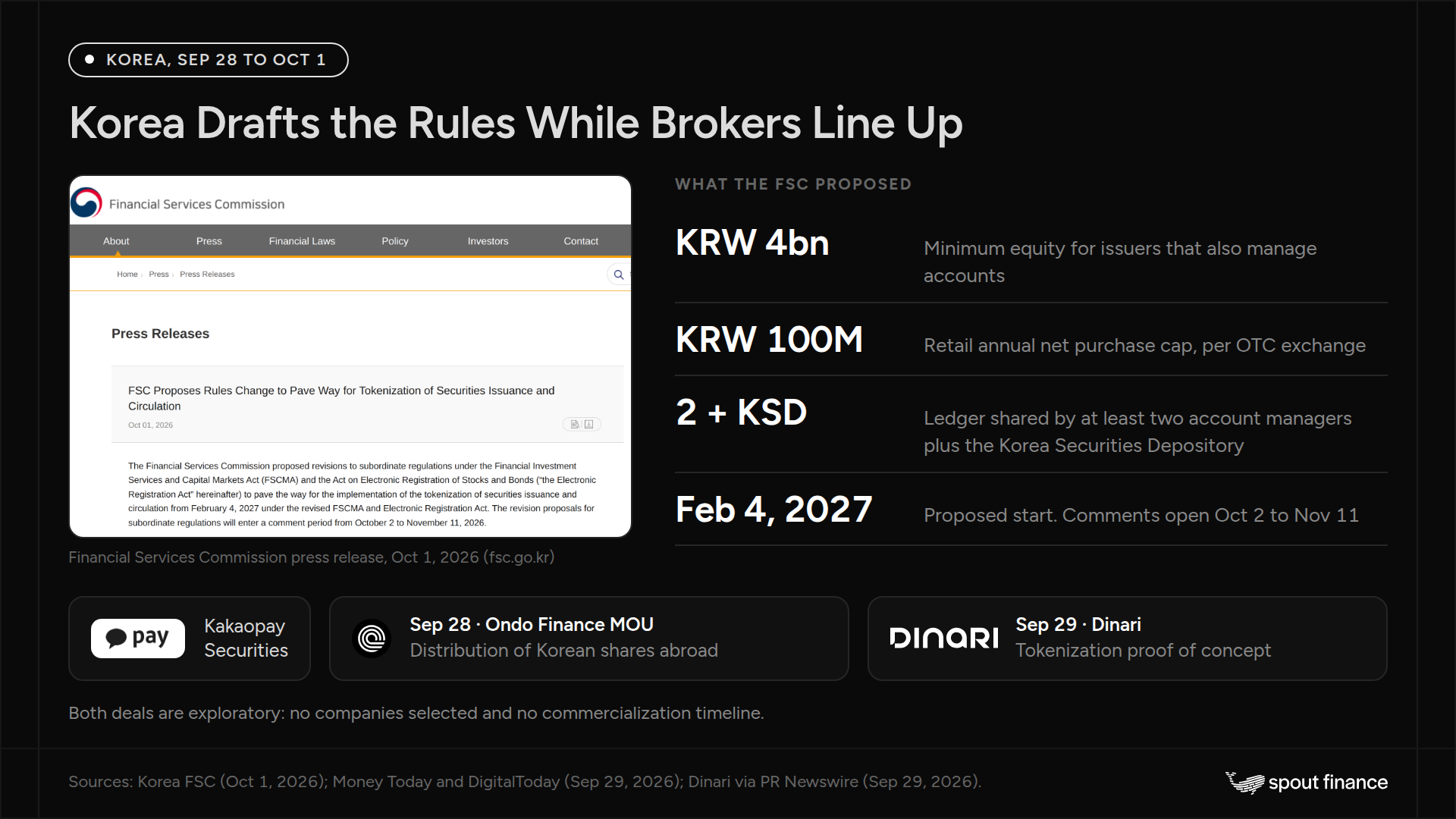
Korea moved further on October 1, when its Financial Services Commission proposed rules for tokenized securities covering stocks, bonds, funds and fractional investment securities. (Financial Services Commission, October 1, 2026)
The proposal calls for shared ledgers operated by at least two account managers alongside the Korea Securities Depository. Issuers that also manage accounts would need at least KRW 4 billion in equity. Retail investors would face an annual net purchase limit of KRW 100 million per OTC exchange.
Comments run from October 2 through November 11, with the proposed framework scheduled to take effect on February 4, 2027.
Korea is also becoming increasingly active at the product level.
On September 28, Kakaopay Securities signed an MOU with Ondo Finance to explore a distribution system for Korean-listed shares outside Korea. The shares would be held through a Kakaopay omnibus account, while both companies study issuance, redemption, dividend rights and voting rights. (Money Today and DigitalToday, September 29, 2026)
The following day, Dinari announced its own partnership with Kakaopay Securities to explore Korean-listed equities through a tokenization proof of concept. The work covers 1:1 issuance and redemption, reconciliation, dividends and voting, with a joint task force planned later this year to study potential international distribution. Korean press describes both agreements as MOUs. (Dinari press release via PR Newswire, September 29, 2026)
Dinari said it offers 724 tokenized US stocks and ETFs. No Korean companies have been selected and there is no commercialization timeline. The release also does not say that US investors will be eligible.
Both partnerships are still exploratory, but they point to a broader trend. Tokenized securities are increasingly being considered as a distribution rail for traditional assets across borders.
 Tokenized funds are becoming collateral
One of the clearest themes of the week was the growing utility of tokenized financial assets.
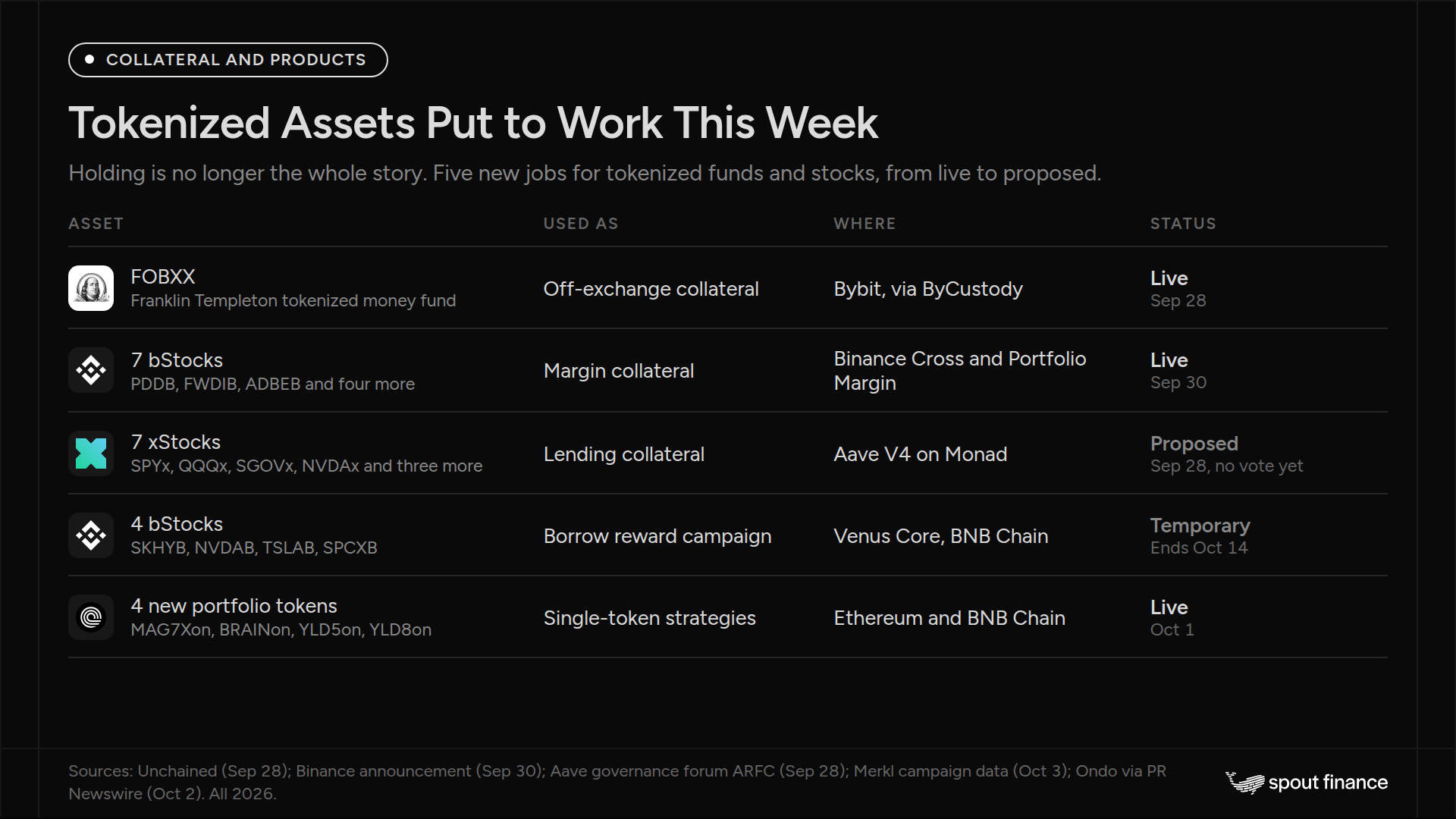
Franklin Templeton’s tokenized US government money fund, FOBXX, became available as off-exchange collateral on Bybit through ByCustody.
The tokenized shares can be posted as collateral for USDT or USDC credit. The available reports did not disclose LTV or haircut terms. Secondary reports put the fund’s assets at roughly $686 million to $687 million, with a 7-day yield of about 3.7% as of September 29. (Unchained, September 28, 2026; The Coin Republic, September 29, 2026)
The important part is the use case.
A tokenized fund does not have to remain something an investor simply holds. It can become collateral for another financial activity.
That same idea is becoming more visible around tokenized equities.
Aave proposes another tokenized-equity lending market
Aave proposed a new V4 Equities Hub on Monad on September 28. (Aave governance forum, ARFC “Deploy Aave V4 on the Monad Network”, September 28, 2026)
Unlike the Aave Equities Hub on Base covered in last week’s roundup, this proposal uses xStocks rather than Coinbase tokenized equities.
The proposed Core spoke includes SPYx, QQQx and SGOVx. SGOVx represents a T-bill ETF rather than an equity. The Growth spoke includes TSLAx, EWYx, NVDAx and SMHx.
USDC and USDT0 would be borrowable. As in Aave’s other markets, borrowers would pay a variable rate that moves with pool utilization.
The proposal uses Chainlink 24/5 xStock price feeds, with a 24/7 feed in development. Collateral factors were sized using the 99th percentile of weekend downside gaps over five years.
The $15 million referenced in the proposal is not new funding. It is the Monad Foundation’s existing incentive budget from the earlier Aave V3.7 deployment, now extended to cover V4.
As of October 3, the proposal remained at the ARFC discussion stage. It had not reached Snapshot, and a reply on October 2 raised concerns around exit liquidity.
The proposal is another sign that tokenized equities are increasingly being considered as collateral inside onchain lending markets.
There was also more detail this week on how the Base hub’s collateral is held. LlamaRisk’s assessment for Aave says the shares behind the seven Coinbase tokens are held by Alpaca Securities, an SEC-registered broker-dealer, in segregated custody accounts in the issuer’s name, and that buyers on the secondary market must complete a vesting step before redemption rights attach. (LlamaRisk, Aave governance forum, September 24, 2026)
A separate Aave governance discussion on X Layer also highlighted the risks involved. Using wTCENTx as a worked example, the discussion noted that minting and redemption for the 79 Hong Kong names on X Layer are unavailable for 84.1% of the week. (Aave governance forum, September 28, 2026)
That is an important distinction for tokenized assets.
A token can exist onchain and still have limited access to the underlying asset. For lending markets, reliable redemption and exit liquidity are part of the product.
Kamino’s institutional credit market keeps growing
Kamino’s Institutional Commodity Yield Vault passed $50 million in deposits on September 29.
DefiLlama showed approximately $51.8 million deposited, with $48.35 million deployed into commodity loans. The vault targets 7%+ yield and launched on August 3 with a $25 million cap. (Solana Compass, citing Kamino and DefiLlama, September 29, 2026)
The product is a USDC lending vault into a Cayman-regulated fund rather than a new tokenized collateral type.
Still, its growth shows the continued demand for institutional credit products inside onchain markets.
Kamino has been shipping new credit products at a steady pace. Its fixed-rate 8% USDC borrowing market against OnRe’s ONyc went live on September 25, the week before this roundup’s window. (OnRe, September 2026 review, October 1, 2026)
Binance expands tokenized stock margin support
On September 30, Binance added seven bStocks to its margin collateral lineup. (Binance announcement, September 30, 2026)
The assets were PDDB, FWDIB, SHAZB, WENB, ADBEB, HPEB and ZMB.
They became available on Cross Margin, Portfolio Margin and Portfolio Margin Pro. The tokens cannot be borrowed and are not available to US users.
This is centralized exchange margin rather than DeFi, but it adds another example of tokenized stocks moving beyond simple spot exposure.
The more financial functions a tokenized asset can support, the more important its underlying infrastructure becomes.
Ethena’s bStocks collateral is still waiting on paperwork
Ethena’s use of Binance bStocks inside USDe, announced the week before, remains a work in progress.
The research prepared for Ethena’s Risk Committee recommended approving the framework and approving bStocks subject to a side letter that was still being negotiated. Until that side letter is in place, the report described the spot leg as unsecured credit exposure to a Binance affiliate rather than a claim on the stock. (Kairos Research for the Ethena Risk Committee, Ethena governance forum, August 28, 2026)
No public confirmation that the side letter has been signed was found this week, and the size of the bStocks allocation has not been disclosed. USDe supply stood at about $4.89 billion on October 3. (DefiLlama, October 3, 2026)
Robinhood’s tokenized-stock market faces the next test
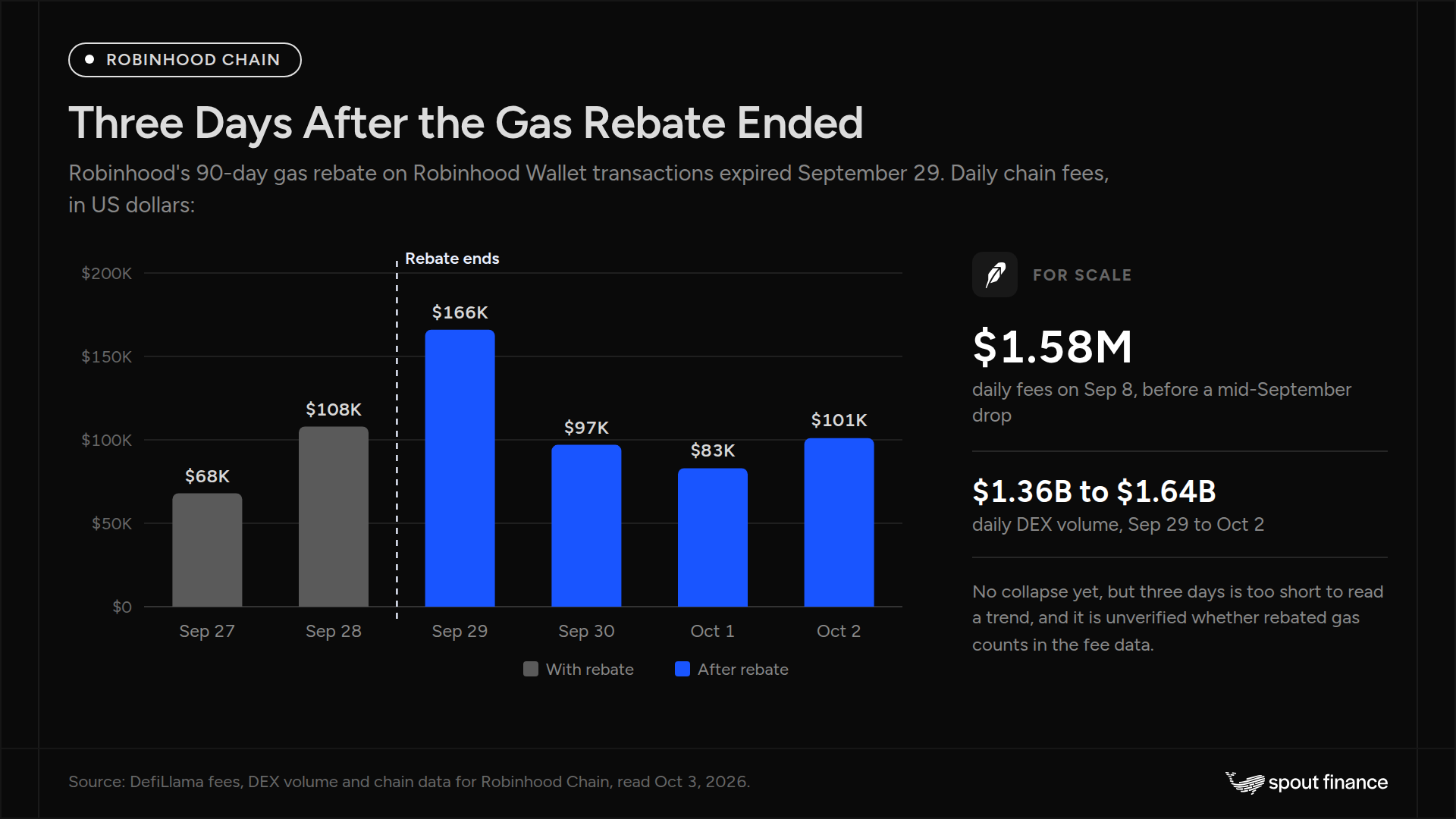
Robinhood’s gas rebate expired on September 29.
The rebate was not a subsidy specifically for tokenized stocks. It was a 90-day gas rebate covering Robinhood Wallet transactions after Robinhood Chain’s public mainnet launched on July 1.
DefiLlama data showed daily chain fees between approximately $68,000 and $166,000 from September 27 through October 2, compared with $1.58 million on September 8.
Daily DEX volume between September 29 and October 2 ranged from approximately $1.36 billion to $1.64 billion.
Chain TVL moved between $1.010 billion and $1.048 billion during the period. (DefiLlama, read October 3, 2026)
There was no visible collapse in activity during the first three days after the rebate ended. That window is too short to draw a conclusion, and it is also unverified whether rebated gas is included in DefiLlama’s fee series.
 Robinhood’s own HOOD Summit announcement on September 29 focused on AI agents, weekend equities trading through Bruce ATS pending regulatory review, US crypto perpetuals through Bitstamp, Cboe earnings contracts, extended options hours and 4x intraday margin. (Robinhood newsroom, September 29, 2026)
It did not announce a new tokenized-stock product.
But tokenized stocks did come up at Korea Blockchain Week.
Robinhood’s Johann Kerbrat said the SEC exemption’s volume caps will bind, noting that Robinhood’s stock-token volume is already high enough that some limits will be reached. (The Block, October 2, 2026)
He also said Robinhood plans to add ETFs, voting rights and in-kind redemption for stock tokens.
No figure was given for how close Robinhood is to the exemption caps.
Not all of the chain’s activity is stock trading. Bloomberg reported on October 2 that stock tokens helped fuel a $440 million memecoin frenzy on Robinhood Chain, though the period behind that figure was not clear in the coverage available. (Bloomberg, October 2, 2026)
The next few weeks should give a clearer picture of what Robinhood Chain activity looks like without the gas rebate.
WisdomTree takes its onchain fund strategy further
WisdomTree launched the WisdomTree Onchain brand on September 29.
The company said its tokenized fund assets have passed $1.2 billion, up from approximately $770 million at the beginning of 2026.
WisdomTree now has 15 SEC-registered tokenized funds across eight chains, including Solana.
The company is also developing an Onchain Markets secondary platform. (WisdomTree investor relations, September 29, 2026)
This is another sign that tokenization is expanding from issuance into the broader lifecycle of financial products, including distribution and secondary markets.
Ondo expands its tokenized portfolios
Ondo expanded its Intelligent Portfolios from three products to seven on October 1, a week after the first three launched.
The four new tokens are MAG7Xon, BRAINon, YLD5on and YLD8on. Ondo said all seven portfolios are available to eligible investors on Ethereum and BNB Chain. No assets or yield figures were disclosed. (Ondo press release via PR Newswire, October 2, 2026)
Single tokens that hold a whole strategy are becoming their own product category, alongside single-stock tokens.
Tokenized options enter the conversation
Cboe and S&P Dow Jones Indices extended their SPX license through 2051.
The announcement also mentioned the possibility of pursuing products beyond traditional index derivatives, including tokenized options contracts. (S&P Dow Jones Indices, September 29, 2026)
There is no product design or launch timeline yet.
The development is relevant to the wider RWA market because it shows tokenization moving into financial products built around assets, not only the assets themselves.
For structured-yield products, that distinction matters.
TradFi continues experimenting with onchain finance
Morgan Stanley launched a Digital Asset Lab on September 29 to test tokenized deposits, money market funds, stablecoins and DeFi vaults. (Bloomberg via crypto.news, September 29, 2026)
The lab is led by Megan Brewer.
Citi also expanded its Token Services into Japan and the UAE during the week. The service now covers seven markets, adding USD tokenized deposits in Japan and USD and EUR tokenized deposits in the UAE. (Citigroup, September 28, 2026)
These are not tokenized-equity products, but they show how broadly financial institutions are experimenting with tokenized assets and onchain settlement.
In Brazil, CSD BR and Ripple are working to mirror BTG Pactual fund-share records on the XRP Ledger. A later phase is expected to target native issuance of CRI and CRA credit instruments. (Unchained, September 30, 2026)
DTCC’s tokenization service, which DTCC said in May would launch in October 2026, had not been announced as live as of October 3. Its tokenization page still describes the launch as later this year. (DTCC, May 4, 2026 press release; DTCC tokenization page, read October 3, 2026)
The pattern is becoming harder to miss. Tokenization is spreading across funds, deposits, bonds, equities and credit instruments.
Solana keeps expanding its tokenized-stock market
Solana had another strong week for tokenized equities.
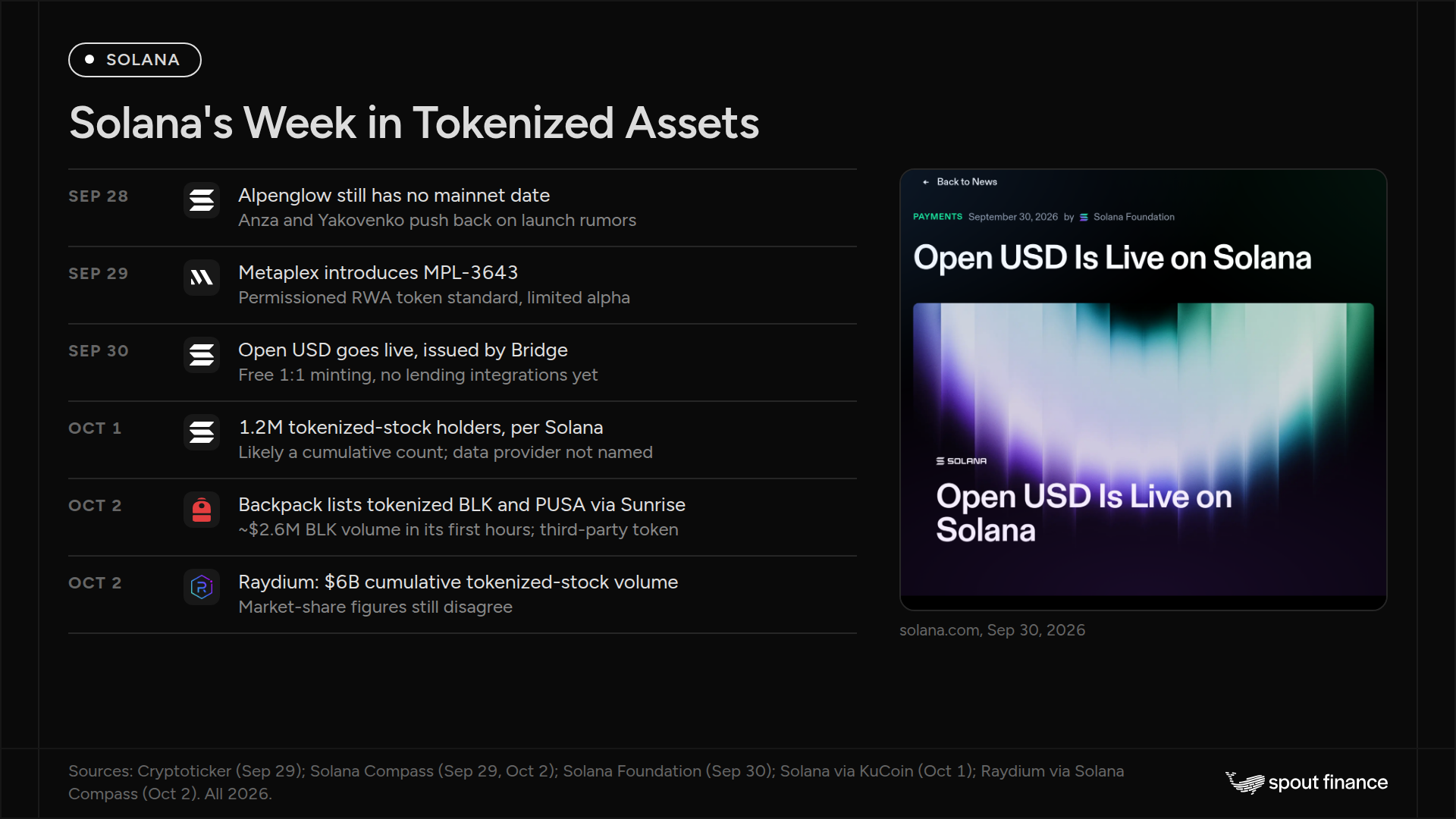
A Solana post reported that tokenized-stock holders reached a record 1.2 million, with 775,000 joining in September. (Solana on X, as reported by KuCoin, October 1, 2026, and TokenPost, October 2, 2026)
The data provider behind those figures was not identified, so the numbers should not be presented as a verified count of current holders. The figure also appears likely to represent a cumulative “ever held” count.
Still, the broader growth in Solana tokenized-stock activity is supported by several other developments.
Backpack Securities listed tokenized Powerus and BlackRock through Sunrise on Solana on October 2.
PUSA went live a day after the Powerus merger closed. BLK trades 24/7 on Raydium, and both assets are 1:1 redeemable.
The tokens are not available to users in the US, UK, UAE or Japan.
Solana Compass measured approximately $2.6 million in BLK volume, more than 3,500 holder wallets and around $1.3 million in circulation at 20:24 UTC on October 2. (Solana Compass, October 2, 2026)
BlackRock has not made a statement about the token, so BLK should not be described as a BlackRock product. It is a third-party tokenization.
Raydium also reported $6 billion in cumulative tokenized-stock volume on Solana. (Raydium on X, via Solana Compass, October 2, 2026)
Market-share numbers are less consistent. Raydium previously claimed more than 90% of tokenized-stock volume, while Birdeye data put the figure at 63.1% on September 30. Because the datasets differ, the share should not be treated as settled.
The $6 billion cumulative volume figure is the cleaner data point.
On the infrastructure side, Solana’s Alpenglow upgrade still has no mainnet date. After rumors of a September 28 mainnet launch circulated, Anza’s Roger Wattenhofer and Solana co-founder Anatoly Yakovenko both pushed back publicly. Anza says mainnet activation will follow an observation period, without saying how long that period will be. (Cryptoticker, September 29, 2026; Bloomingbit, September 28, 2026)
There were also no reported incidents after the September 25 deadline for protocols to move off Switchboard’s oracle, though none of the affected lending protocols has publicly confirmed a completed migration either.
 BNB Chain crosses $1 billion in tokenized stocks and ETFs
BNB Chain also had a major tokenized-stock milestone.
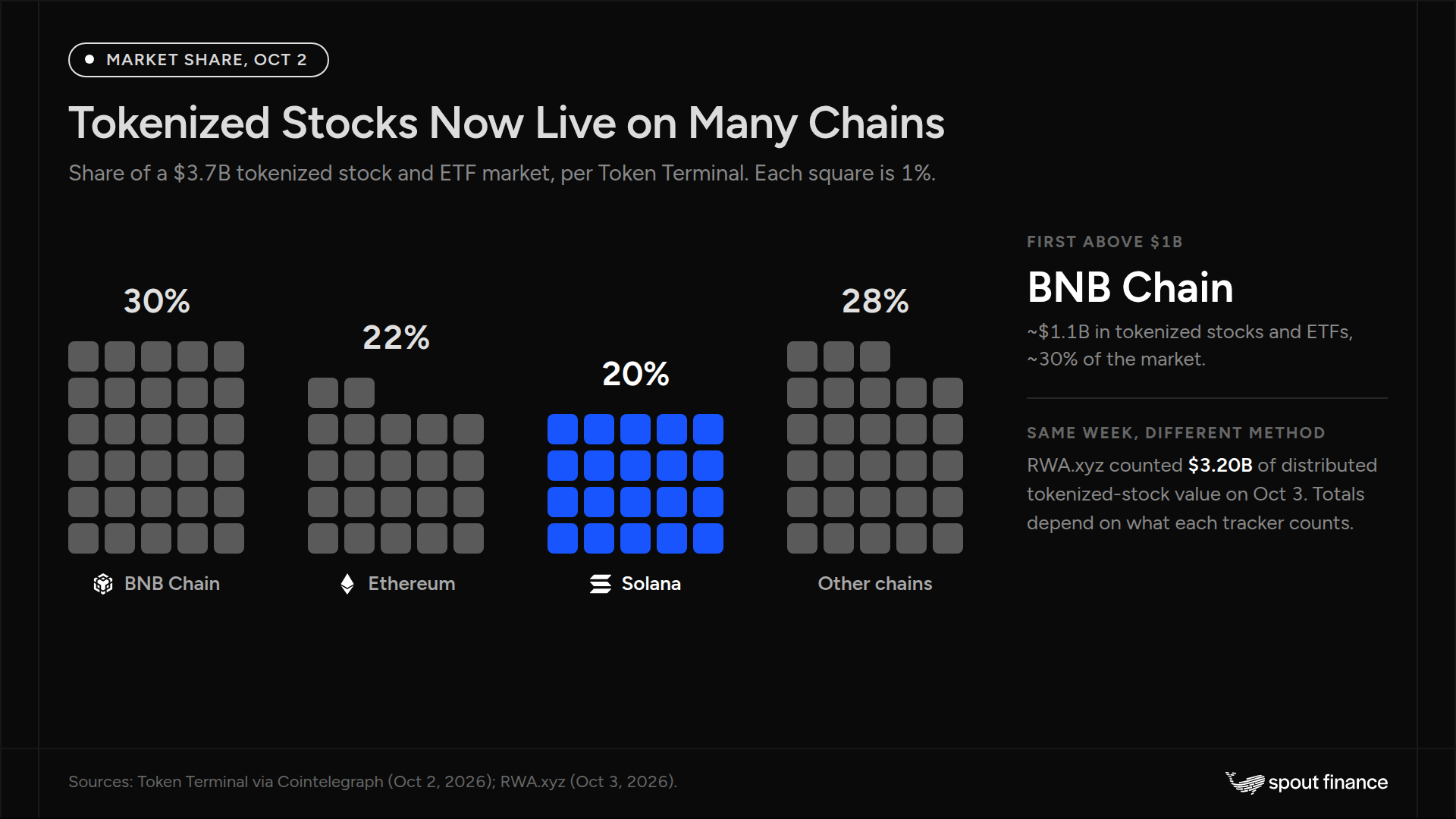
Token Terminal data cited by Cointelegraph put BNB Chain above $1 billion in tokenized stocks and ETFs, at approximately $1.1 billion. (Cointelegraph, citing Token Terminal, October 2, 2026)
That represented roughly 30% of a $3.7 billion market in the cited dataset. Ethereum represented 22% and Solana 20%.
Other datasets show different market totals.
RWA.xyz showed $3.20 billion in distributed tokenized-stock value on October 3. (RWA.xyz, October 3, 2026)
The difference comes down to methodology and measurement, so these figures should be read alongside their respective sources rather than treated as one definitive market-size number.
The broader takeaway is that tokenized stocks are no longer concentrated on one chain or one distribution model.
 Base adds more tokenized stocks
Base reportedly added 26 more Coinbase tokenized stocks on October 2. (ChainCatcher, citing Base on X, October 2, 2026)
Reports mentioned names including Oracle and Netflix, although the full ticker list was garbled in the available coverage and could not be independently verified.
The expansion adds to a broader trend across tokenized stock platforms.
More issuers and more chains are increasing the number of publicly accessible tokenized equities.
The harder question is whether greater access translates into deeper liquidity and sustained usage.
Metaplex brings permissioned RWA infrastructure to Solana
Metaplex introduced MPL-3643, a permissioned RWA token standard built for Solana, on September 29. (Solana Compass, September 29, 2026)
The standard uses Token-2022, the Solana Attestation Service and Token ACL.
It is currently in limited-access alpha.
Orca, Raydium, Jupiter, Phantom and Solflare are expected to integrate it, although those integrations are planned rather than live.
No issuer has been named.
For tokenized securities, infrastructure like this can become increasingly important as issuers need to manage permissions and compliance while still using public blockchain rails.
Open USD goes live on Solana
The Solana Foundation announced on September 30 that Open USD, or OUSD, is live on Solana. (Solana Foundation, September 30, 2026)
Issued by Bridge, OUSD supports free 1:1 minting.
Coinbase, Mastercard, Shopify, Stripe and Visa were named as founding partners, with the Solana Foundation stating that more than $1 billion has been committed to liquidity.
No lending integrations were announced.
For Solana, another dollar-denominated asset adds to the liquidity base available for future onchain financial applications.
Tokenized stocks are becoming part of broader financial products
Taken together, the week’s developments show a market moving beyond tokenization as an endpoint.
Franklin Templeton’s tokenized money fund is being used as collateral.
Binance is using tokenized stocks as margin collateral.
Aave is proposing xStocks as collateral on Monad.
Ondo is expanding tokenized portfolio products from three to seven.
WisdomTree is building around more than $1.2 billion in tokenized fund assets and developing a secondary market.
Robinhood is looking at ETFs, voting rights and in-kind redemption for stock tokens.
Cboe and S&P DJI are discussing tokenized options.
The common thread is utility.
The asset being onchain is becoming less interesting on its own. What matters more is what financial activity can happen around it.
Lending, collateral, structured products and portfolio construction are where that activity is starting to show up.
 The yield market is shifting too
The macro backdrop changed slightly this week.
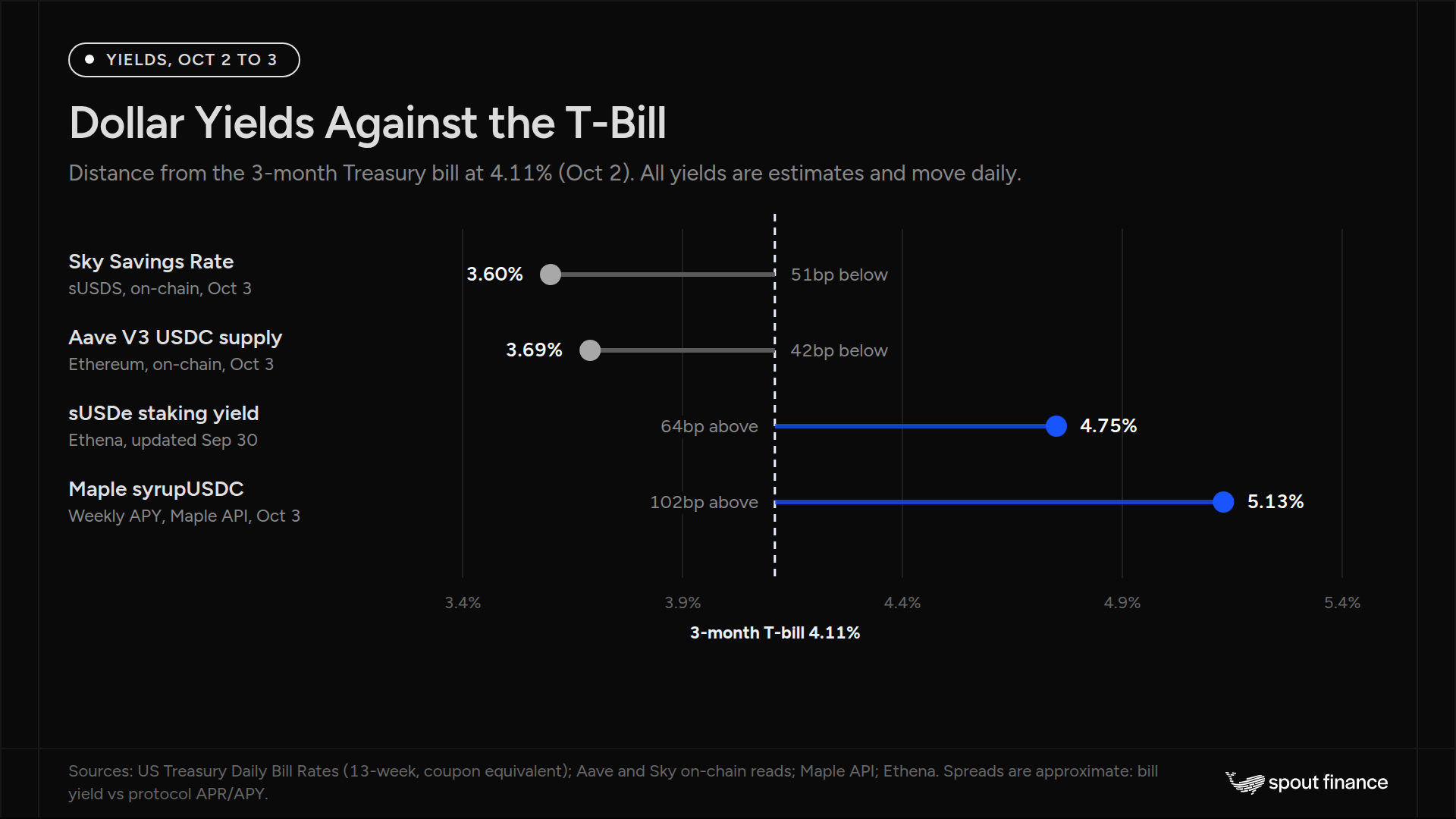
The 3-month Treasury bill moved from 4.20% on September 28 to 4.11% on October 2, a decline of 9 basis points over the week and 7 basis points below the 4.18% reading on September 25. (US Treasury, Daily Treasury Bill Rates, 13-week coupon equivalent)
There was no FOMC meeting during the week.
Federal Reserve Governor Barr said on September 29 that further policy adjustments are likely to be needed. Vice Chair Jefferson flagged upside risks to inflation on October 1. (Federal Reserve speeches, September 29 and October 1, 2026)
The next FOMC meeting is scheduled for October 27 to 28.
Against that backdrop, Aave V3 Ethereum USDC supply was 3.69% APR on October 3, up from 3.54% last week and roughly 42 basis points below the 3-month Treasury bill. (Aave V3 on-chain reserve data, October 3, 2026)
Sky Savings Rate remained at 3.60%, around 51 basis points below the bill. (Sky sUSDS contract, October 3, 2026)
Maple syrupUSDC was at 5.13% weekly APY, approximately 102 basis points above the bill. (Maple API, October 3, 2026)
sUSDe staking yield was 4.75% as of September 30, about 64 basis points above the bill. (Ethena, last updated September 30, 2026)
All of these yields are estimates that move daily. The spreads are approximate because Treasury yields and protocol APR or APY figures measure different things.
 The important part for onchain lending is where the yield comes from.
A higher rate is only part of the equation. The underlying mechanism, collateral, market structure and sustainability of the yield matter too.
Solana ETF flows cool down
Solana spot ETF flows were much quieter this week. (Farside Investors, read October 3, 2026)
September 28 brought $7.7 million of net inflows.
September 29 brought $5.4 million.
September 30 saw $12.5 million of net outflows.
October 1 saw another $1.1 million of outflows.
October 2 brought $1.3 million of inflows.
The week finished with approximately $0.8 million in net inflows.
That is a sharp slowdown from the previous week’s $188.1 million, and it included two outflow days after a week in which every trading day saw inflows.
DeFi lending continues to grow, but the numbers need context
DefiLlama’s October 3 data gives a useful snapshot of where major lending protocols stood. (DefiLlama, read October 3, 2026; 7-day and 30-day changes from daily data)
Aave V3 was at $18.11B, down 1.2% over seven days and up 6.8% over 30 days.
Morpho Blue was at $11.31B, up 2.8% over seven days and 19.8% over 30 days.
Maple was at $2.99B, down 0.4% over seven days and up 1.5% over 30 days.
Kamino Lend was at $1.39B, down 5.9% over seven days and up 12.3% over 30 days.
Lista DAO was at $1.34B, down 2.4% over seven days and up 8.5% over 30 days.
Venus Core Pool was at $1.33B, down 1.7% over seven days and up 7.4% over 30 days.
Jupiter Lend was at $1.30B, up 8.8% over seven days and 20.9% over 30 days.
Lista Lending was at $1.02B, up 11.5% over seven days and 23.5% over 30 days.
USD.AI was at $319.3M, up 50.5% over seven days and 38.5% over 30 days.
Aave Horizon was at $257.5M, down 3.6% over seven days and up 0.5% over 30 days.
Figure Markets Democratized Prime was at $239.2M, up 21.3% over seven days and down 2.8% over 30 days.
Loopscale was at $98.95M, up 19.3% over seven days and 10.8% over 30 days.
Pareto Credit was at approximately $160K, up 0.1% over seven days and 4.5% over 30 days.
TVL does not include borrowed funds on DefiLlama, which means the figures can understate activity for some lending markets.
On October 3, Figure had $590.3 million borrowed, Pareto Credit had $209.9 million, USD.AI had $311.8 million and Loopscale had $51.1 million.
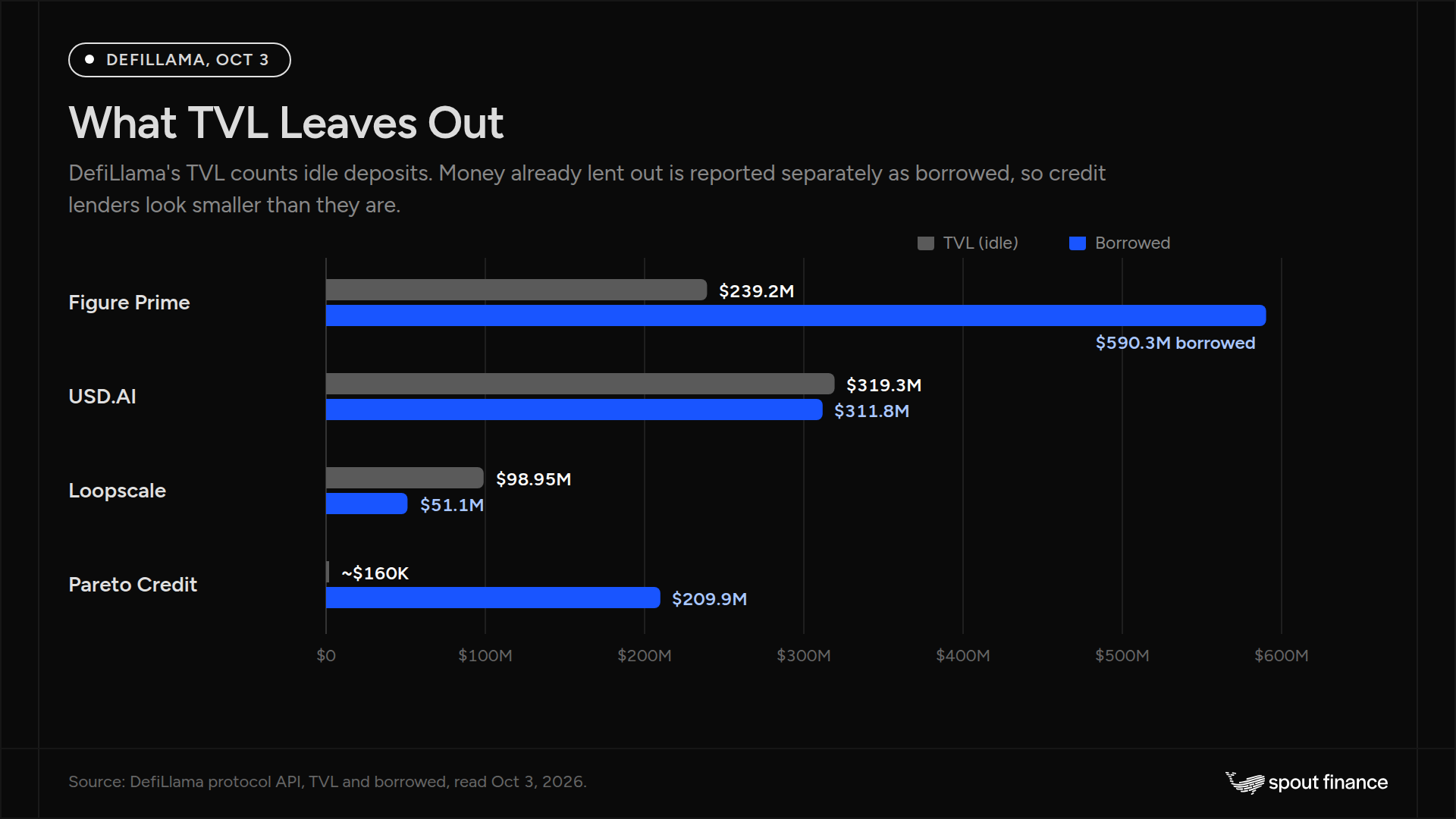 USD.AI’s 50.5% weekly TVL increase also needs context. The move appears to have come largely from loans coming off the book rather than new deposits. Idle PYUSD increased by approximately $96 million while borrowed funds fell by around $88 million on October 2. Idle plus borrowed capital increased by only about 7% from September 26 to October 2.
Lista Lending’s increase also appears to have been an internal migration. Its slisBNB balance rose from approximately $388 million to $531 million on October 1 while Lista CDP fell from roughly $220 million to $84 million. The parent protocol remained broadly flat.
Where this leaves tokenized equities
The biggest change this week is not one particular launch.
It is the number of financial functions now being attached to tokenized assets.
Trading is expanding.
Collateral use is expanding.
Lending markets are expanding.
Tokenized funds are growing.
Portfolio products are becoming more sophisticated.
Institutional banks are testing tokenized deposits and DeFi.
Regulators are working through custody, settlement, redemption and investor-rights questions.
And Solana continues to add tokenized assets, trading activity and infrastructure around them.
At the same time, the market is starting to confront the harder side of tokenization.
A tokenized stock needs reliable redemption.
A lending market needs enough liquidity for users to exit.
Collateral needs dependable pricing.
A tokenized fund needs a clear structure around ownership and custody.
And an asset that exists onchain still needs a reason for users to keep using it.
That last part is becoming increasingly important.
What this means for Spout Finance
Spout Finance is entering a market where tokenized equities are becoming useful in more parts of the financial system.
This week showed that clearly. Tokenized funds are being used as collateral, exchanges are adding tokenized stocks to margin systems, and lending protocols are exploring more ways to use tokenized equities inside credit markets.
For Spout, this reinforces the value of building around what users can do with a tokenized equity rather than tokenization itself.
Spout lets individuals borrow stablecoins against their tokenized stocks without selling their underlying exposure, with borrowers paying 0% interest.
The lender yield comes from covered-call premiums written against the collateral, rather than token emissions or temporary incentives.
As more platforms bring tokenized equities into lending, the source of the yield becomes just as important as the borrowing rate. A temporary reward can reduce borrowing costs for a campaign, but it does not create a lasting lending model.
Spout is built around a different mechanism.
The tokenized equity is the starting point. The goal is to make it useful as financial collateral.
What to watch next
The SEC’s proposed custody rules will move into their comment period after Federal Register publication.
Korea’s proposed tokenized-securities framework will remain open for comments through November 11.
Whether DTCC’s tokenization service launches in October as planned, and whether it covers equities at launch.
Whether Aave’s Monad Equities Hub proposal moves to a Snapshot vote.
Robinhood Chain will provide a longer view of activity after the gas rebate ended.
Whether Ethena’s bStocks side letter is finalized.
Venus’ current bStocks incentive program ends on October 14.
TOKEN2049 Singapore runs October 7 to 8, bringing together major players from across the global crypto and Web3 ecosystem.
The SEC’s Tokenized Securities Venue framework will continue to attract industry feedback around ownership verification, redemption and interoperability.
And across Solana, Ethereum, BNB Chain and other networks, the next question remains the same.
As tokenized stocks and other real-world assets become easier to access, will users simply hold them, or will they start using them as the building blocks for a much broader onchain financial system?