Weekly RWA Roundup: Tokenized Finance Moves Deeper Into Onchain Markets
Market & Insights
August 22, 2026
Tokenized equities are becoming collateral, institutional credit is moving onchain, and stablecoins are taking on bigger roles in finance. Here’s what changed across RWA, DeFi, TradFi and Solana this week.

The week of August 16–22 brought another wave of activity across real-world assets, traditional finance, DeFi, regulation, and the Solana ecosystem.
Tokenized equities expanded into more markets. Institutional credit moved further onchain. U.S. regulators introduced new proposals. Financial institutions continued testing blockchain-based settlement. Meanwhile, Solana reached fresh highs across tokenized equity supply and network performance.
Here’s what stood out this week.
Tokenized equities move further into mainstream markets
Tokenized equities continued gaining ground this week, with the market expanding across both crypto-native platforms and traditional financial infrastructure.
One of the biggest developments came on August 18, when Kraken launched access to more than 7,000 U.S.-listed stocks for eligible customers across the European Economic Area. The rollout also placed more than 700 xStocks alongside traditional equities and crypto assets within the same account.
The significance goes beyond the number of stocks available.
Users are increasingly seeing traditional equities and blockchain-based assets within the same financial platforms. The separation between conventional markets and digital asset markets is becoming less pronounced as platforms bring different forms of financial exposure into a single interface.
Tokenized equities are also becoming more useful within DeFi.
On August 18, Securitize and Neuberger Berman launched HINC, a tokenized high-yield fund. Two days later, a proposal on Aave Horizon called for HINC to be added as lending collateral, and Securitize’s SECZ tokenized equity was connected to Loopscale’s lending markets on Solana, giving a freshly listed stock a role in onchain credit within weeks of its NYSE debut.
This points toward a broader development in the RWA sector. Tokenization is increasingly being paired with financial utility.
An asset represented onchain has more potential applications when it becomes compatible with lending, collateral and liquidity markets.
Institutional credit moves onchain
One of the clearest examples arrived on August 19.
Ethena and FalconX announced a
The structure pushes digital-asset capital into institutional credit rather than keeping it entirely within crypto-native trading strategies.
It also highlights a wider search for yield.
As traditional and digital markets become more connected, capital is moving toward different sources of return, including secured lending, credit and structured strategies.
This is important for the wider RWA market because lending is one of the areas where tokenized assets gain additional functionality.
A tokenized asset becomes more useful when it is accepted as collateral, connected to credit markets or incorporated into an investment strategy.
Regulation enters another phase
U.S. crypto regulation also moved forward on several fronts this week.
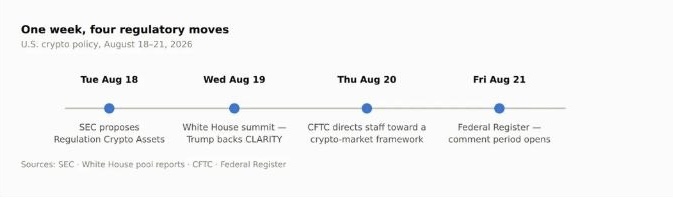
On August 18, the SEC proposed Regulation Crypto Assets, including proposed exemptions for certain crypto offerings and a safe harbor. The proposal was published in the Federal Register on August 21, beginning the formal comment period.
Then on August 19, the White House hosted a crypto summit where President Donald Trump called on Congress to pass what he described as a “fair version” of the CLARITY Act.
The event added political momentum to a regulatory debate that has been unfolding for months.
Trump also said the CFTC was working toward bringing Hyperliquid to the U.S., adding another indication of the administration’s interest in expanding digital asset activity within U.S. markets.
The CFTC followed the next day with its inaugural Innovation Advisory Committee meeting.
CFTC Chairman Mike Selig directed the agency toward developing a framework for crypto asset markets, whether or not the CLARITY Act advances.
The result is a regulatory landscape moving on multiple tracks at once.
Congress is working on legislation. The SEC is developing rules around crypto offerings. The CFTC is examining market structure and digital commodities.
For tokenized assets, these developments matter because clearer definitions around issuance, trading, custody and market participation shape how financial products enter the digital economy.
Stablecoins are becoming part of financial infrastructure
Stablecoins also continued moving beyond their traditional role within crypto markets.
On August 19, the Financial Accounting Standards Board floated a proposal to treat qualifying stablecoins as cash equivalents, requiring on-demand redemption, a direct issuer relationship and fully reserved short-term backing. If adopted, the treatment would give stablecoins a much clearer position in corporate accounting, one of the quiet barriers to institutional adoption.
Competition around stablecoin infrastructure also picked up. Visa began searching for a new stablecoin settlement partner following Mastercard’s acquisition of BVNK, and X was reported to be exploring stablecoins for creator and influencer payouts, with USDC emerging as a leading option.
The week’s biggest example, though, remained the Ethena and FalconX facility, where assets backing USDe are being deployed into institutional lending.
The direction is becoming increasingly clear. Stablecoins are being tested as settlement assets, payment instruments, collateral and sources of capital within financial infrastructure.
This creates another layer for tokenized markets.
If tokenized assets represent financial value onchain, stablecoins provide one of the main forms of digital settlement for transactions involving those assets.
The two markets therefore continue developing alongside each other.
Traditional banks continue experimenting with blockchain
Institutional adoption also extended beyond crypto-native companies.
On August 19, HSBC and Standard Chartered completed the first live cross-bank tokenized-deposit transfer through Swift’s blockchain-based ledger.
The development gives traditional banking another use case for blockchain infrastructure.
Instead of focusing on speculative assets, the transaction involved tokenized deposits and bank-to-bank settlement.
This is part of a larger trend where financial institutions are testing blockchain for functions already handled by existing financial systems.
The focus is shifting toward efficiency, settlement and programmable financial infrastructure.
At the same time, Shinhan Asset Management, a Korean institution with roughly $96B in assets under management, signed an MOU on August 21 around a Korean won-denominated tokenized fund on Solana, bringing another major traditional financial institution into the tokenization conversation.
Macro markets added another layer
The broader financial market also had a major week.
The Federal Reserve released the minutes from its July meeting on August 19. The decision to hold rates had been split, with three members dissenting in favor of a 25-basis-point increase.
The minutes arrived as markets continued assessing the direction of U.S. monetary policy.
Crypto markets reacted strongly during the week.
Bitcoin broke above $69K on August 20 and pressed toward the $80K area, while more than $4B in short positions were liquidated during the broader move.
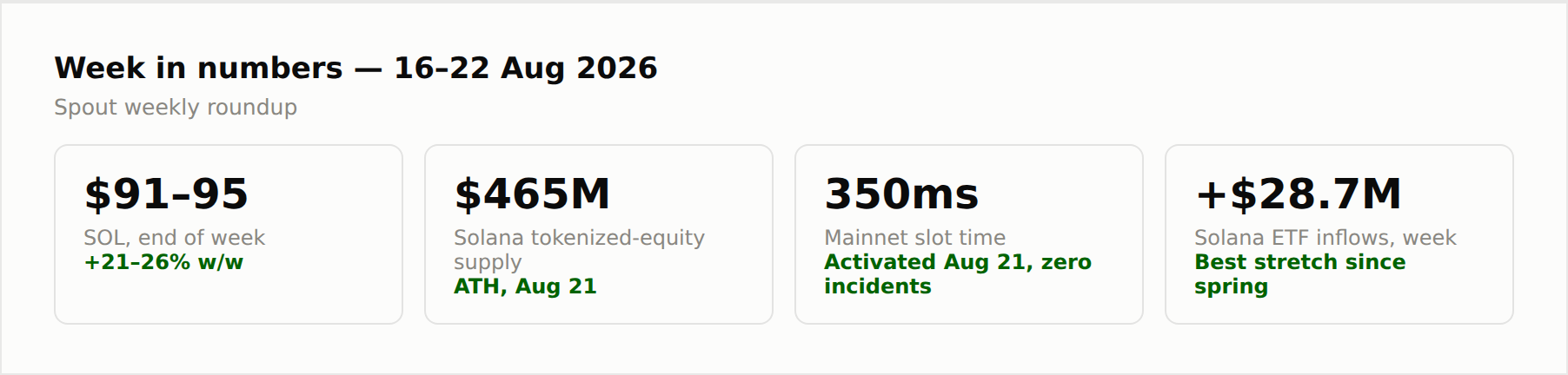
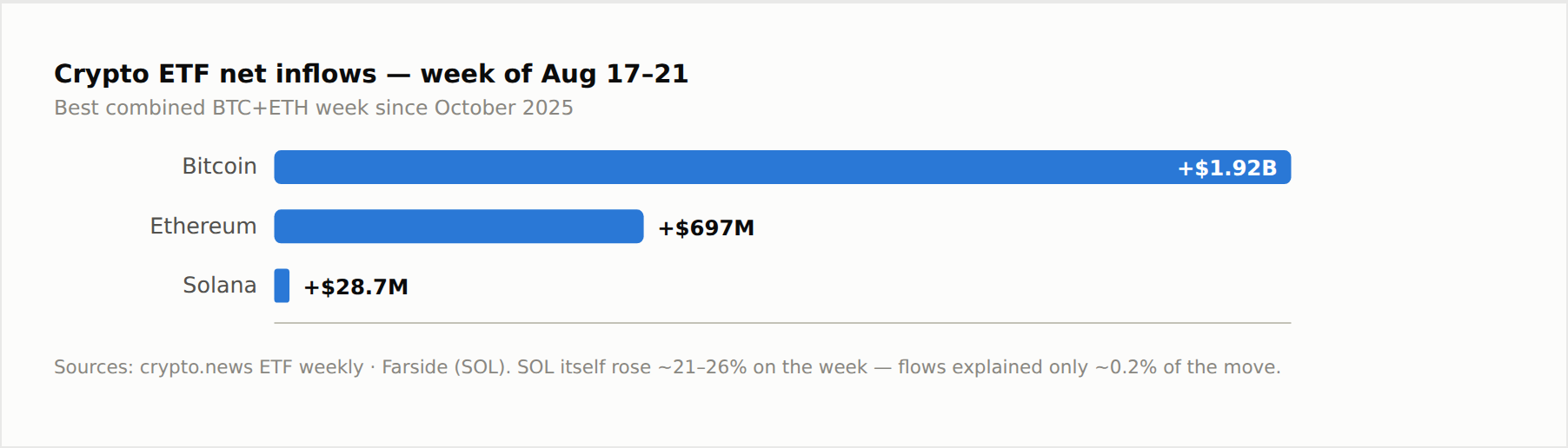
SOL had its best week since spring, rising roughly 21–26% to the $92–95 area, driven more by the network’s upgrade catalyst and broad risk-on than by fund flows.
Bitcoin and Ethereum ETFs also recorded their strongest weekly performance since October 2025, with roughly
Solana ETFs recorded approximately
The market environment therefore provided a stronger backdrop for digital assets while institutional capital continued entering through regulated products.
Solana reaches a new tokenized-equity milestone
Solana also recorded another milestone in its RWA activity.
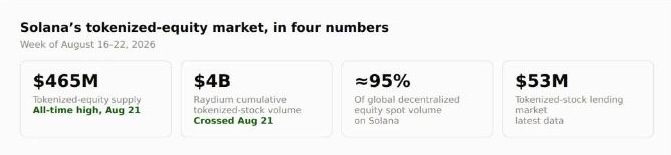
Tokenized equity supply on the network crossed $465M, a new all-time high.
The figure is specifically the tokenized-equity supply milestone. It should not be confused with the $378M in 30-day tokenized-Treasury inflows reported earlier in the week.
The distinction matters because the two figures measure different areas of the market.
The $465M figure reflects the value of tokenized equities supplied on Solana, while the $378M figure relates to tokenized Treasury inflows over a 30-day period.
Solana also continued expanding the infrastructure around these markets.
Raydium crossed $4B in cumulative tokenized-stock volume, giving another indication of how much activity tokenized equities are generating within the ecosystem.
The growth is happening across both supply and trading infrastructure.
Solana infrastructure gets faster
August 21 also marked an important network upgrade.
SIMD-0525 activated at epoch 1020, reducing Solana’s slot time to 350ms. It was the first reduction in slot time since the network launched, and the activation took place without reported incidents.
There is an important distinction here.
The 350ms slot-time change went live this week. Transaction V1, which targets 4,096-byte transactions, and the proposed 90% rent reduction had not shipped yet.
Those changes remain separate pieces of Solana’s broader infrastructure roadmap.
The Alpenglow bug bounty also closed during the week, with updated guidance pointing toward October for its next stage.
Together, these developments show an ecosystem continuing to work on both immediate performance improvements and longer-term infrastructure upgrades.
Governance becomes more active
Solana also entered a new stage in network governance.
The network’s first onchain governance vote opened on August 22, covering SGP-0001, SGP-0002 and SGP-0003.
The proposals require a 66.67% threshold for approval.
The vote is not a formality. HSDT publicly stated positions supporting SGP-0001 while opposing SGP-0002 and SGP-0003, showing that there is active disagreement around the proposals.
This adds another dimension to Solana’s development.
Changes to the network are increasingly becoming matters for validator participation and governance rather than decisions happening entirely behind the scenes.
The ecosystem continues to diversify
Solana’s activity this week also extended beyond tokenized securities.
Bank Leumi became the first Israeli bank to offer customers trading in Bitcoin, Ether and SOL.
Ramp introduced x402 agent wallets on Solana, targeting autonomous payments for more than 70,000 businesses.
Jupiter’s aggregator share also fell below 50% for the first time, while Raydium’s growing tokenized-stock volume added another sign of shifting activity across the ecosystem.
The result is a network supporting an increasingly broad collection of financial activity.
Tokenized equities, commodities, lending, payments, stablecoins and institutional products are all developing within the same environment.
Where the market stands
This week brought several developments pointing in the same direction.
Traditional financial institutions are testing blockchain settlement.
Crypto platforms are bringing thousands of conventional stocks alongside tokenized versions of equities.
Institutional capital is entering secured onchain lending.
Regulators are building new frameworks for digital assets.
Tokenized equities are gaining supply and trading volume.
And blockchain infrastructure is continuing to improve.
The market is therefore moving beyond the early question of whether real-world assets belong onchain.
The focus is increasingly shifting toward what happens after they arrive.
How are they traded?
How are they used as collateral?
How do they generate yield?
How do they connect with stablecoins?
How easily can users access them?
Those questions are becoming increasingly important as tokenized finance moves from asset representation toward a more complete financial system.
DeFi moves toward more useful RWA markets
The biggest shift this week was not the number of assets entering the market. It was the number of ways those assets are starting to interact with DeFi.
Tokenized stocks are becoming collateral. Funds are being considered for lending markets. Structured products are being designed around digital assets. Institutional credit facilities are bringing larger pools of capital into onchain lending.
One figure stands out here.
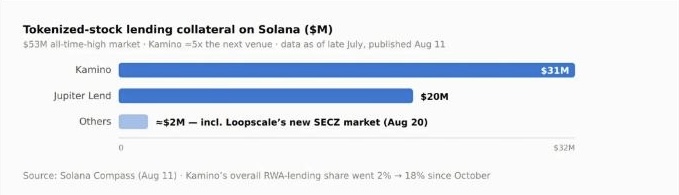
As of the latest available data, Kamino accounted for 82.6% of Solana’s roughly $53M tokenized-stock lending market. The figure shows how quickly lending around tokenized equities has developed and how concentrated the market still is.
Jupiter also introduced a promotional lending rate as low as 0.4% for borrowing against xStocks.
These developments move tokenized equities closer to functioning as financial instruments rather than assets people simply hold.
The direction is important for users because access to an asset becomes more useful when there are multiple financial actions available around it.
Yield strategies are becoming more sophisticated
Another development worth watching came from Bitwise and Lombard.
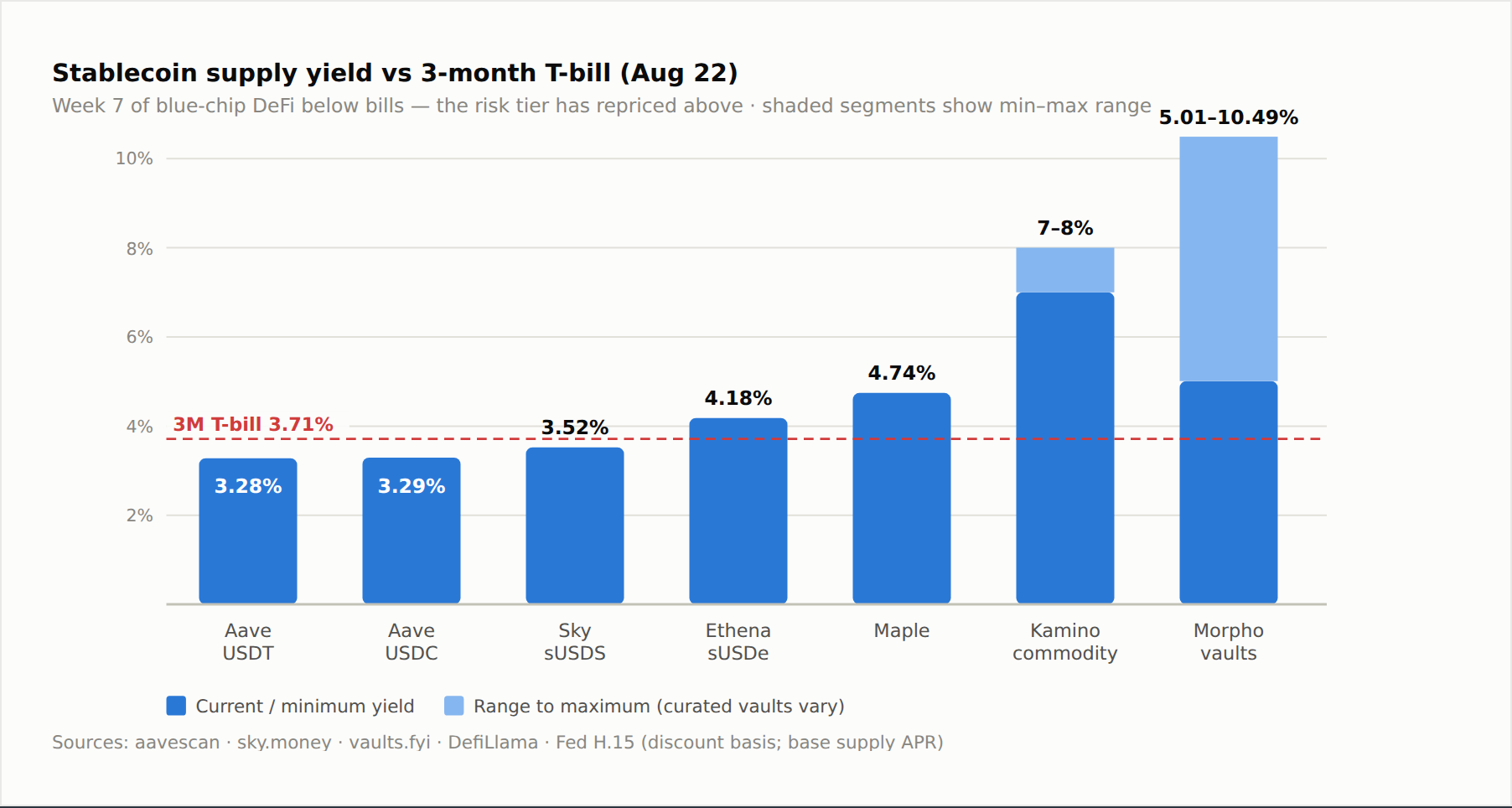
The two firms began rolling out an institutional Bitcoin covered-call strategy targeting roughly 2.5% net yield, with the rollout expected to reach full scale in September.
Covered-call strategies bring options into the yield conversation.
Instead of relying solely on lending rates or staking rewards, investors can generate returns through option premiums while maintaining exposure to an underlying asset.
This reflects a broader search for sustainable sources of onchain yield.
Institutional investors are increasingly looking beyond simple asset appreciation and lending markets. They are exploring structured approaches designed around volatility, options and cash flow.
That shift is relevant to the wider RWA market because users are increasingly looking for financial products with defined strategies behind their returns.
The market is becoming more competitive
The growth of tokenized finance is also bringing more platforms into the same space.
Kraken’s expansion into thousands of U.S. stocks, Securitize’s tokenized funds, Kamino’s lending activity, Jupiter’s lending products and other institutional offerings all point toward a market where access is becoming easier and competition is increasing.
For users, this means the quality of the financial experience becomes increasingly important.
Having access to an asset is one thing.
Having transparent pricing, useful liquidity, understandable yield sources and practical borrowing options is another.
As more platforms enter tokenized finance, these differences will become easier for users to notice.
Security remains part of the equation
The week also brought reminders that growth in DeFi comes with operational challenges.
Maya Protocol suffered an exploit involving roughly
On August 22, BounceBit announced the shutdown of its Layer 1 following an exploit, while MANTRA also experienced a halt.
A Rust crates supply-chain attack also affected components connected to the wider blockchain ecosystem.
These incidents reinforce the importance of infrastructure quality as more financial value moves onchain.
As tokenized assets become collateral and lending markets grow, security becomes increasingly tied to the user experience.
The market needs infrastructure capable of handling financial assets without introducing unnecessary points of failure.
What This Means for Spout Finance
The most important shift this week was the growing connection between tokenized assets and actual DeFi utility.
On August 20, Securitize’s SECZ, a tokenized equity product, was connected to Loopscale’s lending markets on Solana. The move gave a tokenized stock a role beyond simple price exposure. It showed how an onchain representation of a traditional asset can become part of a lending market and serve as collateral.
Aave was moving in a similar direction. A proposal on Aave Horizon called for HINC, the tokenized high-yield fund from Neuberger Berman and Securitize, to be added as collateral. The direction is clear. Tokenized assets are moving deeper into DeFi infrastructure, where they can support borrowing, lending and other financial activity.
The lending market around tokenized equities is already developing. As of the latest available data, Kamino accounted for 82.6% of Solana’s roughly $53M tokenized-stock lending market. Jupiter Lend also pushed aggressive borrowing incentives, with a promotional rate as low as 0.4% against eligible tokenized assets.
This is an important development for Spout because the opportunity extends beyond putting real-world assets onchain. The bigger opportunity sits in what users do with those assets after they own them.
Spout Finance is building toward a model where tokenized equities become productive financial assets. Users get exposure to real-world markets, then gain access to additional ways to use that exposure within DeFi.
That brings us to yield.
The market is starting to explore more ways of generating returns from financial assets. On August 19, Ethena and FalconX announced a
These developments reinforce a broader trend around structured yield. Capital is looking beyond simple holding strategies and toward financial products designed to generate additional returns from underlying assets.
For Spout Finance, this is closely aligned with what is being built.
The idea is not to ask users to choose between exposure to traditional assets and DeFi opportunities. Spout brings those two sides closer together, giving users a way to access tokenized equities while putting that capital to work through onchain financial strategies.
The next step is almost here.
Our beta goes live on testnet on August 24, giving users their first look at what we’ve been building around tokenized equities, collateral, borrowing and yield.
The market is moving beyond putting real-world assets onchain. The focus is shifting toward what users can actually do with them once they’re there.
We’re building for that next stage, and on August 24, you’ll get to see it start taking shape.