Weekly Roundup: What Happens After Assets Go Onchain
Market & Insights
September 12, 2026
Another week of RWA, tokenized stocks, DeFi and TradFi. From tokenized equity markets and onchain lending to stablecoins and Solana, here’s what moved across the real-world assets market.

The RWA market saw another week of financial infrastructure taking shape.
Tokenized stocks continued to expand across markets, institutional credit moved further onchain, banks kept testing stablecoin settlement, and traditional financial institutions continued building around tokenized securities.
The important shift is where this activity is taking place.
The market is moving past the question of whether real-world assets can exist onchain.
The bigger question now is what financial products can be built around those assets.
This week brought developments across tokenized equities, private credit, stablecoins and onchain lending. Taken together, they point in the same direction: tokenized assets are beginning to function as part of financial infrastructure rather than remaining isolated digital representations of traditional assets.
Tokenized equities are moving closer to traditional market infrastructure
One of the biggest developments this week came from Nasdaq.
Nasdaq's venture arm agreed to invest
The partnership also brings Nasdaq's market-surveillance technology to Payward, with the companies targeting a Q2 2027 launch for Nasdaq Equity Tokens.
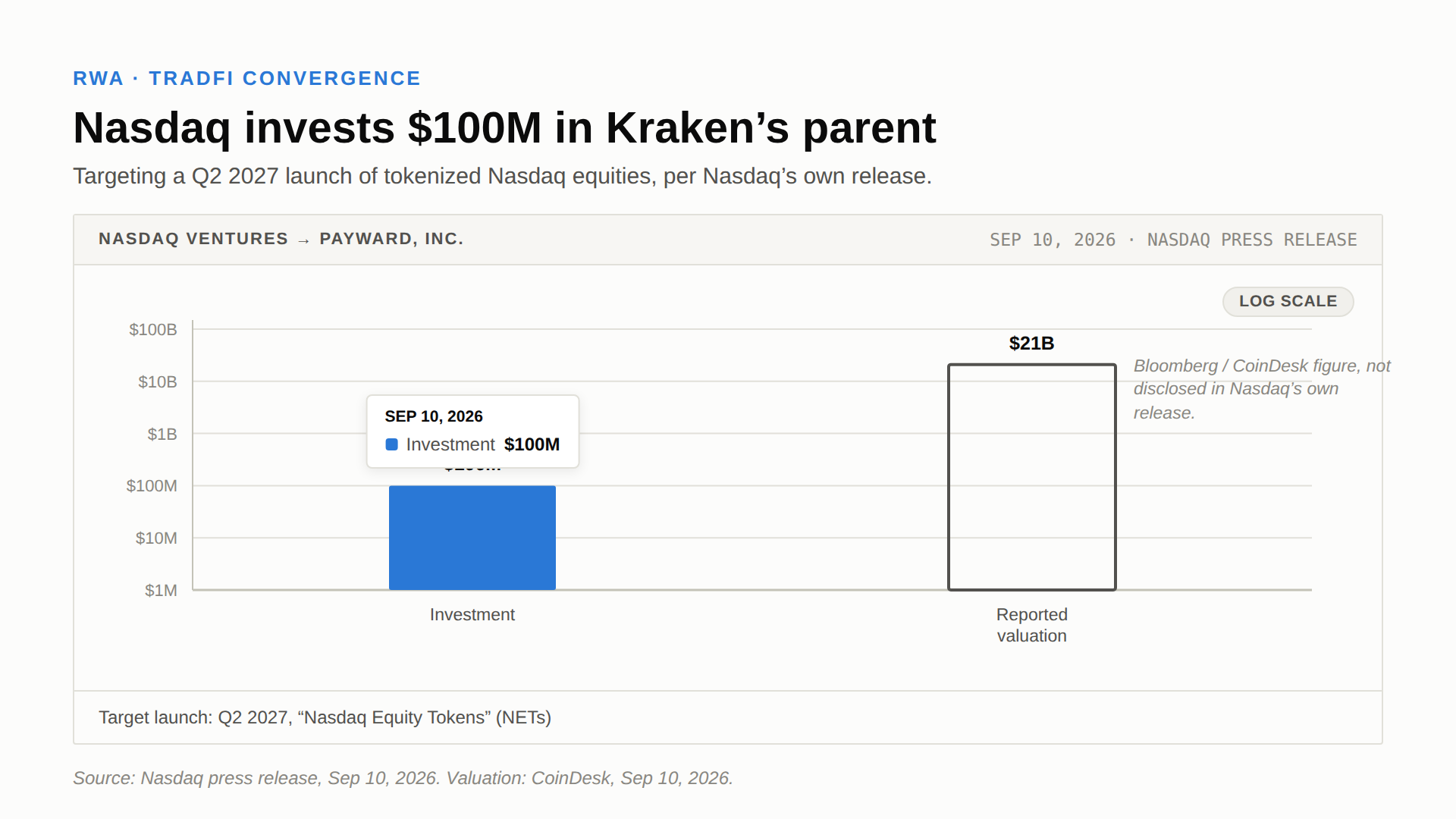 That sends a different signal from another crypto company simply adding a handful of tokenized stocks.
A major market infrastructure provider is working directly with a crypto-native financial platform to build systems around tokenized equities.
At the same time, OKX expanded 24/7 access to 100 tokenized stocks and ETFs for European traders, including Nvidia, Google, Palantir, SPY and QQQ.
It also introduced perpetual futures with up to 10x leverage based on OpenAI and Anthropic valuations. These products do not offer equity ownership, but their arrival alongside tokenized stocks shows how quickly traditional market exposure is being adapted for always-on financial markets.
Robinhood's own chain also saw its tokenized stocks reach
The direction is becoming increasingly difficult to miss.
Stocks are no longer coming onchain simply as another way to hold an asset.
They are becoming building blocks for new financial products.
The next step is putting those assets to work
Morpho made that shift even clearer this week.
A Morpho Blue market using tokenized S&P 500 exposure through SPYx as collateral recorded more than $6.3 million in deposits across September 8 and 9.
The market itself is not new. It launched in March.
What changed this week was the growth in deposits and the disclosure around the market's participants, including Flowdesk, Agora and xStocks.
That distinction is important.
The key development is not another tokenized asset being created.
It is capital starting to move around an existing tokenized asset.
Once an equity token becomes collateral, it is no longer only an investment representation.
It becomes part of a lending market.
The same pattern is emerging in private credit.
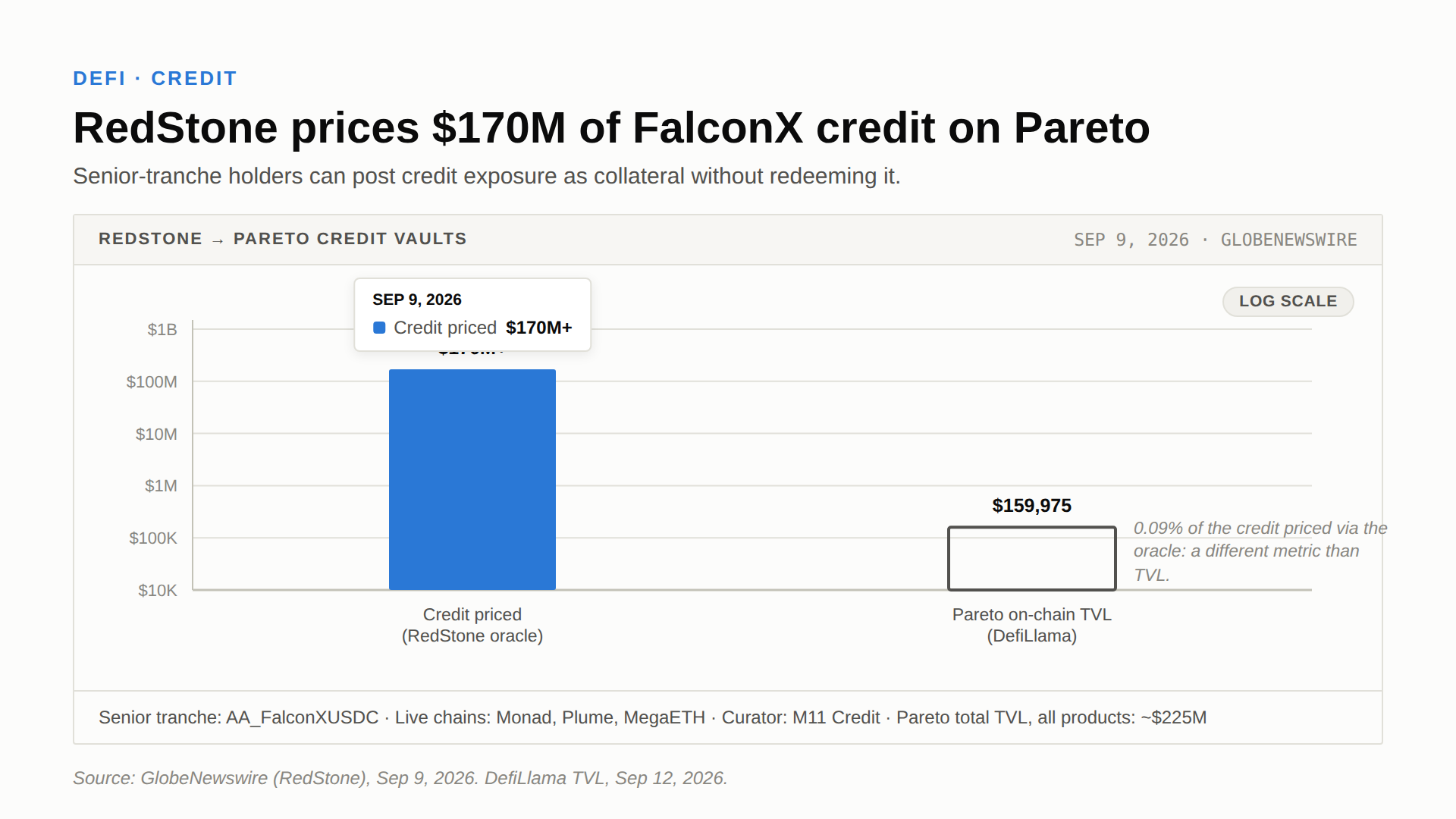
RedStone began pricing more than
Senior-tranche holders can use the tokenized position as collateral to borrow liquidity without redeeming it, allowing the underlying yield to keep accruing.
It is a useful example of the direction the RWA market is taking.
The asset does not have to be sold to create liquidity.
It can become part of the financing layer itself.
Stablecoins are becoming financial infrastructure
Banks are moving in a similar direction, although from a different part of the stack.
US Bank ran a live cross-border pilot for its proprietary USBDC stablecoin on Stellar, testing minting, payments, redemption, freezing and clawback while connecting the system to its internal infrastructure.
This is less about launching another stablecoin and more about testing what happens when bank money can move through programmable settlement infrastructure.
Circle made its own move this week, agreeing to acquire Singapore-based Tazapay for approximately $400 million in stock.
Tazapay processes more than
Together, these developments point toward a financial system where stablecoins increasingly sit between traditional financial institutions and onchain applications.
That matters for RWAs because tokenized assets require more than a token standard.
They need settlement assets.
They need liquidity.
They need credit markets.
And they need financial infrastructure capable of moving value around them.
The number of holders keeps growing, but activity tells a more complicated story
RWA.xyz data reported this week showed distributed tokenized-asset holders reaching an all-time high of 3.67 million, including 2.96 million holders of tokenized stocks.
That represents a significant increase in the number of addresses holding tokenized assets.
But monthly transfer volume was reported at
The numbers point to two different trends.
Ownership is growing.
Activity is less consistent.
That matters because a growing holder base does not automatically mean tokenized assets are deeply integrated into financial markets.
The real test is what holders actually do with those assets.
Do they trade them?
Use them as collateral?
Borrow against them?
Use them within structured strategies?
Move them between financial applications?
That is where utility begins to matter.
The yield comparison is getting tougher
The broader market backdrop made that question even more relevant this week.
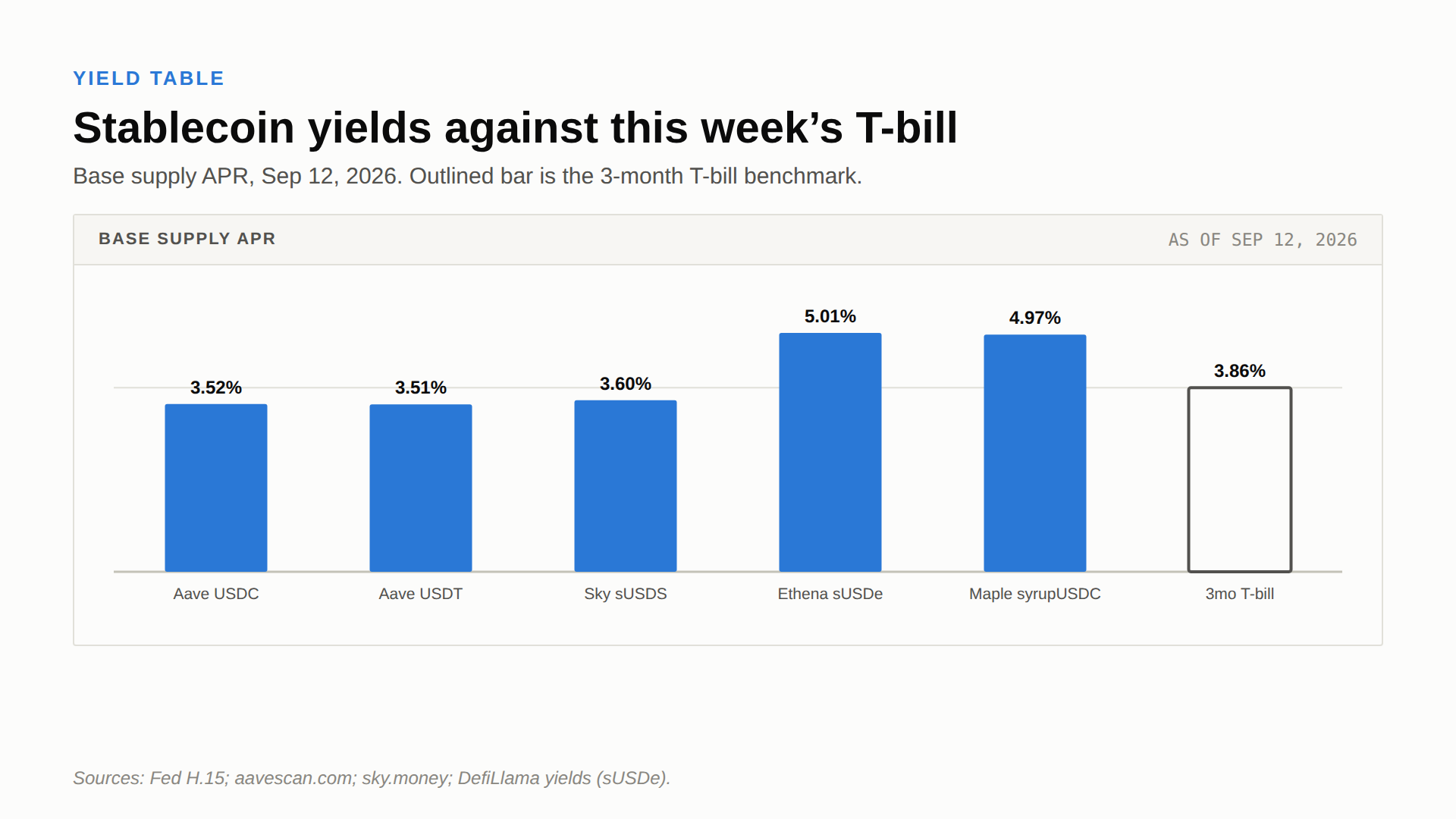
Three-month Treasury bills rose from 3.75% last week to 3.86% by September 10.
At the same time, Aave's base USDC supply rate fell to around 3.52%, with utilization at 91.4%.
That leaves the two roughly 34 basis points apart.
Last week, the gap was only around 13 basis points.
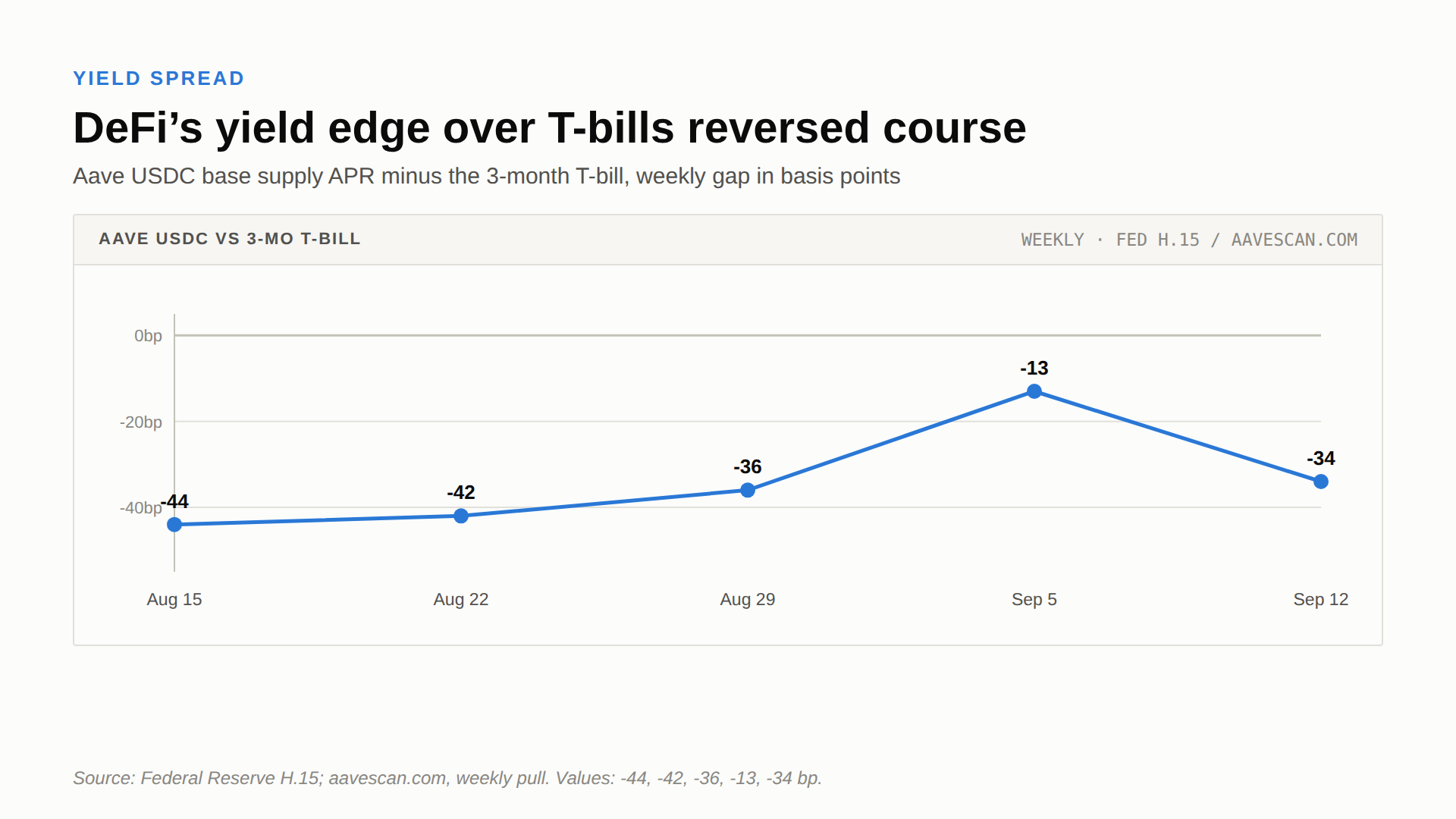 Not every onchain yield moved in the same direction. Ethena's sUSDe (around 5.01%) and Maple's syrupUSDC (around 4.98%) both remained well above the T-bill this week, by roughly 115 and 112 basis points respectively, even as Aave's edge nearly disappeared. (Sources: DefiLlama, aavescan.com, September 12, 2026.)
The change is small in absolute terms, but the direction is worth watching.
Onchain yield is competing with traditional financial products offering relatively low-risk returns.
That makes APY alone a weaker way to evaluate a financial product.
A 5% yield backed by one type of activity is not the same as a 5% yield backed by another.
The source matters.
The collateral matters.
The strategy matters.
And the risks involved in generating that return matter.
This is especially important for RWAs because the appeal of bringing traditional assets onchain lies in the possibility of connecting them to a broader financial system.
If the asset simply sits there, tokenization has only solved the first problem.
The market is starting to build around the asset
That may be the clearest takeaway from this week.
Nasdaq is working with Kraken's parent company on tokenized-equity infrastructure.
Morpho is seeing real deposits enter a tokenized-equity collateral market.
RedStone is bringing institutional prime-brokerage credit into onchain markets.
Banks are testing stablecoins for settlement.
Tokenized-stock holders are reaching new highs.
And traditional Treasury yields continue to set a benchmark for what capital can earn outside crypto.
The pieces are starting to connect.
The next phase of the RWA market will not be defined only by how many assets become tokenized.
It will be defined by how many financial functions those assets can perform once they are onchain.
That is where the opportunity becomes more interesting.
It is also where the infrastructure underneath these markets starts to matter.
Solana had a quieter week, but the infrastructure story continued
Compared with the number of developments across the broader RWA market, Solana had a quieter stretch.
SOL traded mostly between
The move was notable, but it did not change the broader picture. After gaining roughly 50% in August, SOL spent most of the week consolidating rather than extending that rally.
Institutional interest also remained steady. US spot Solana ETFs had passed
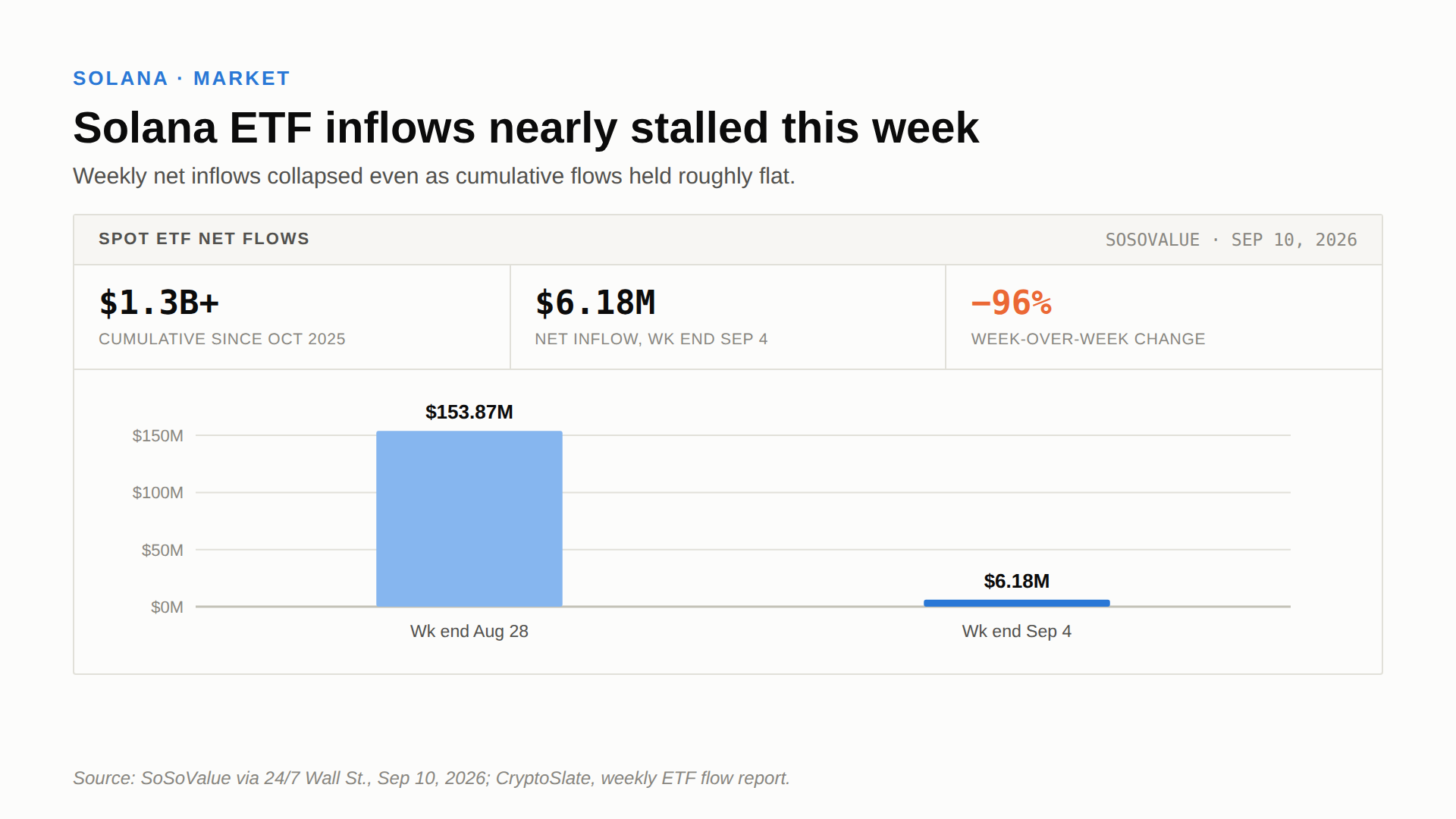 Tokenized equities on Solana also reached a new mark this week: supply crossed $684 million, a record, according to a Solana account post relayed by several outlets on September 11.
The infrastructure side was quieter as well. Transaction V1 was scheduled for September 9, but there was no confirmed mainnet activation during the period. It therefore should not be treated as a completed network upgrade yet.
There was also no major Solana exploit or outage during the week.
That might sound uneventful, but it provides useful context for the RWA story. Solana does not need a new headline every few days for the ecosystem to keep developing. The more important question is which financial applications are being built on the infrastructure already in place.
And tokenized equities are becoming one of the more interesting categories.
The asset is only the starting point
Across the RWA market, this week’s activity pointed to the same shift discussed earlier: tokenization is becoming less interesting as an endpoint and more interesting as an entry point.
A tokenized stock can be held.
But it can also serve as collateral.
It can support a loan.
It can be deposited into a lending market.
It can interact with stablecoins.
It can become part of a structured yield strategy.
That is a much larger opportunity than simply creating a blockchain representation of an existing security.
The growth around the SPYx/AUSD market on Morpho is a good example. The market itself launched in March, so it is not a new launch from this week. What is new is the activity around it, with deposits passing $6.3 million over two days and Flowdesk identified as the curator.
The numbers remain small compared with the broader lending market, but the structure is more important than the size.
A tokenized ETF is being used as collateral.
A stablecoin provides the borrowing side.
A DeFi money market connects the two.
The tokenized asset is doing something.
The same idea appeared in a different form through RedStone and Pareto’s work with FalconX. More than
Different asset. Different market. Same direction.
The value of tokenization increases when an asset can participate in more financial functions.
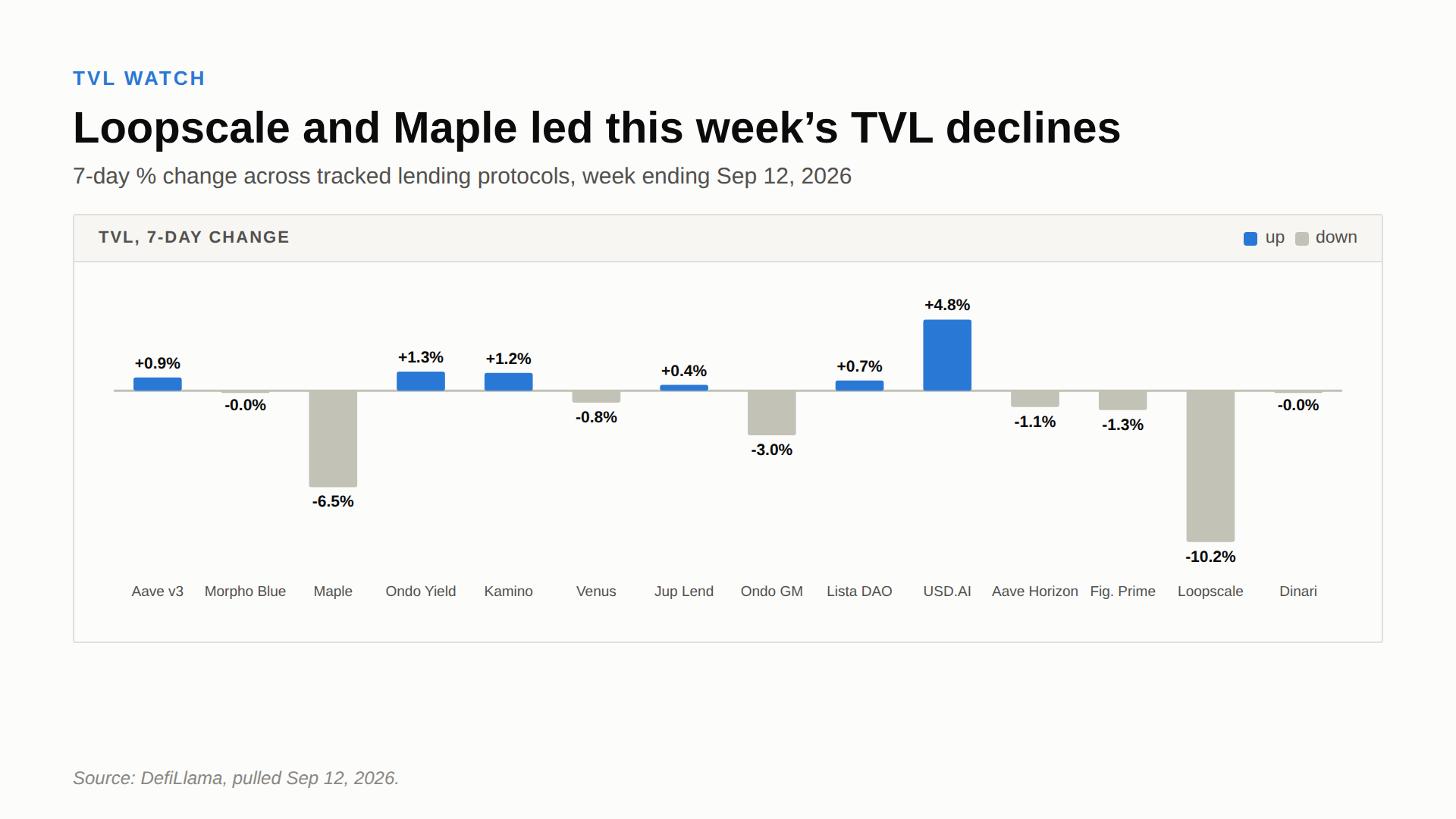
The lending market Spout competes in also moved unevenly this week:
 This is where Spout's model fits
Spout is building around that second layer of the market.
The goal is not simply to put equities on Solana and give users another place to hold them. The more interesting question is what those tokenized equities can do once they are there.
Spout uses tokenized equities as the foundation for a lending system where users can borrow stablecoins against their positions instead of selling the underlying asset.
That creates a different relationship between an investor and their portfolio.
Traditionally, needing liquidity often means selling an asset.
With collateralized borrowing, the asset can remain in the position while its value is used to access capital.
For someone holding a tokenized stock, that creates another option:
Don't sell. Borrow.
The distinction becomes more important as tokenized equity markets grow.
If tokenized stocks are going to become a meaningful part of onchain finance, they need to do more than replicate the ownership experience of traditional markets. They need to connect with the financial tools people already use to manage capital.
Borrowing is one of those tools.
Yield is another.
The source of yield matters more as competition increases
The other side of Spout's model is lending.
This week’s yield data shows why the source of that yield deserves as much attention as the APY itself.
The three-month Treasury bill yield climbed from around 3.75% to 3.86% during the week. Meanwhile, Aave's base USDC lending rate fell from roughly 3.62% to 3.52%.
That widened the gap between the two from around 13 basis points to roughly 34 basis points.
 For users, this makes the headline APY less useful on its own.
A higher number does not automatically make a product better.
The questions become:
Where does the yield come from?
What generates it?
What collateral supports it?
What happens when markets move against the position?
How does the protocol handle liquidation?
For Spout, lender yield comes from covered-call premiums written against the collateral rather than token emissions.
That connects the yield to an underlying financial strategy rather than relying on incentives that can disappear when emissions change.
But the structure still comes with risk.
The underlying equities can fall in value. Covered-call strategies have their own trade-offs. Collateral needs to remain properly priced, and liquidation systems need to function when markets move quickly.
That is why transparency around the mechanics matters just as much as the yield number.
Tokenized equities can give users more ways to use the same asset
This is where the market becomes more interesting from a user’s perspective.
A tokenized stock does not have to be something a user buys and waits to sell.
It can become part of a broader financial position.
Someone can hold the asset for its market exposure while using it as collateral for stablecoin liquidity. Another user can provide liquidity to the lending side and earn yield generated by the underlying strategy.
The roles are different, but they are connected through the same asset.
That creates a more capital-efficient model than treating tokenized equities as purely passive investments.
It also changes how users can think about liquidity.
Needing capital does not automatically mean giving up the asset.
A user who believes in the long-term value of their equity position might prefer to borrow against it rather than sell it and lose that exposure.
That is the core utility Spout is trying to build around tokenized equities.
The market is moving toward financial utility
The developments across RWA, DeFi and traditional finance this week all point in the same broader direction.
Nasdaq and Kraken are working on infrastructure for tokenized equities.
Morpho is seeing more capital move into a market using tokenized stocks as collateral.
RedStone and Pareto are showing how tokenized credit can participate in institutional financing.
Banks are testing stablecoins as part of payment and settlement infrastructure.
Solana continues to provide the blockchain environment for financial applications built around these assets.
None of these developments alone defines where the market is headed.
Together, they show that tokenization is becoming the beginning of the financial product rather than the end of it.
That is the opportunity Spout is building around.
The future of tokenized equities is not only about being able to own a stock onchain. It is about what that stock can do once it gets there.
For Spout users, that means an equity position can potentially become more than an investment to hold. It can become collateral for borrowing, while the lending side can connect that same asset to a yield-generating strategy.
The underlying asset remains important, but the financial layer built around it is where the real utility starts to appear.
That is the next stage of the RWA market: moving from tokenized assets to assets that can actually participate in financial markets.