Weekly Roundup: Tokenized Equities Get More Financial Utility
Market & Insights
September 26, 2026
Tokenized equities are finding more places to go beyond trading. This week brought new lending markets, tokenized funds, institutional moves and a closer look at whether demand is keeping up.

The tokenized-equity market had a different kind of week.
Last week was dominated by regulatory developments and the growing infrastructure around tokenized stocks. This week, the market started getting tested on another level: demand, distribution, collateral use, institutional adoption, and whether tokenized assets can actually become useful financial products.
That produced a more mixed picture.
OKX’s tokenized-stock lineup kept expanding inside its existing app. Aave launched an Equities Hub where eligible non-US users can borrow USDC against seven Coinbase-issued tokenized stocks. ARK Invest moved its venture fund onchain through Securitize, while Ondo launched tokenized portfolio products built around model strategies supplied by BlackRock. Dinari kept building out its own institutional push.
At the same time, TD Securities questioned how much demand actually exists for tokenized stocks today, while Robinhood’s tokenized-stock activity faces an important test when its fee subsidy expires next week, and regulators are still working through gaps in the framework that made this week’s launches possible.
The market is getting bigger.
It is also starting to face harder questions.
Tokenized stocks are meeting real demand
One of the more important developments this week was not a launch.
It was a question about whether users actually want these products.
On September 21, TD Securities said it sees limited near-term demand for tokenized stocks despite the regulatory developments around the sector.
Analyst Reid Noch pointed to Figure Technologies data showing that 99.9% of notional volume still trades through traditional Nasdaq-listed shares rather than their tokenized versions.
A separate Binance snapshot showed that 96% of Nvidia-related notional volume sat in perpetual futures, compared with 4% in the spot tokenized product. (CoinDesk, September 21, 2026)
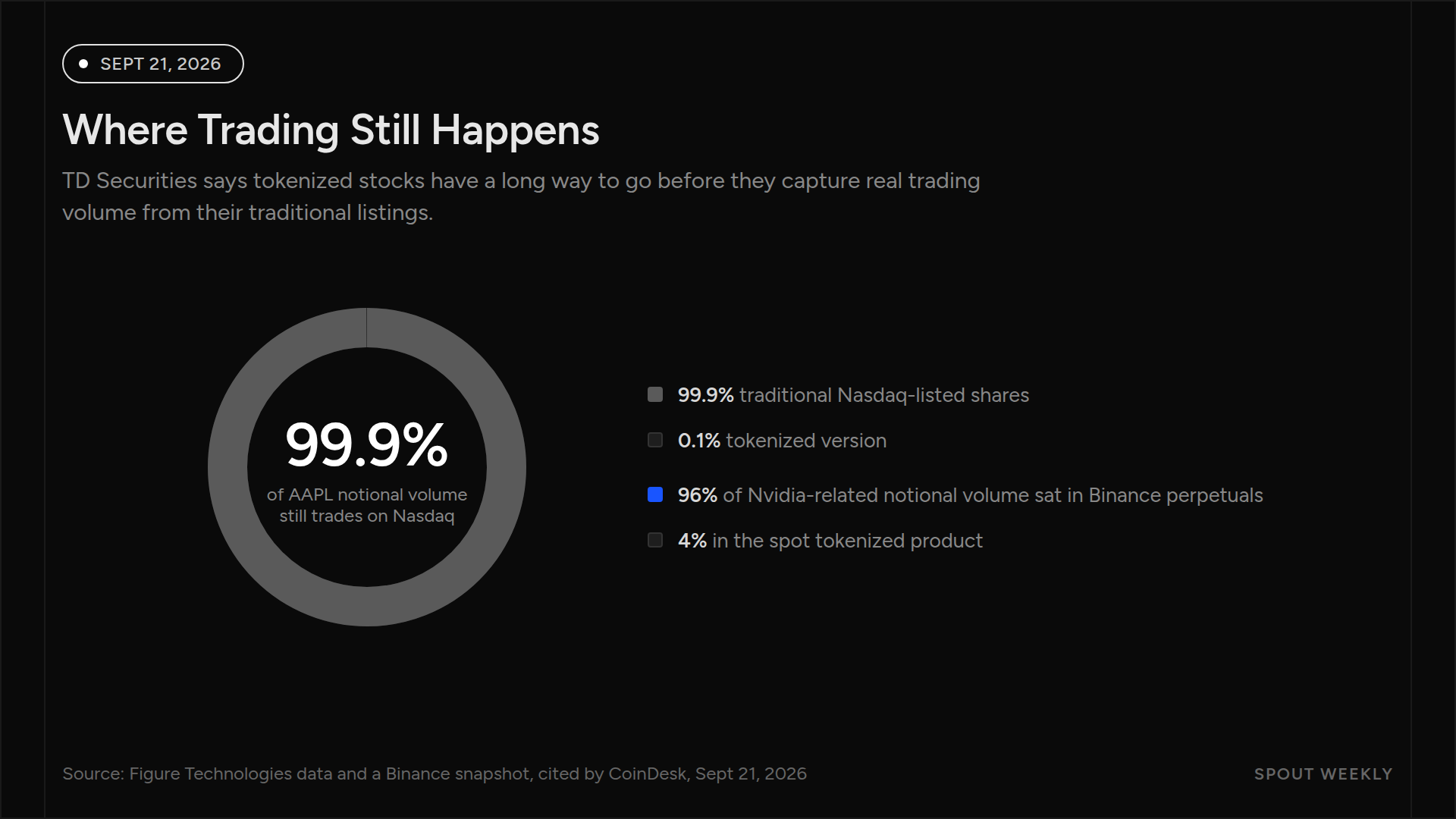 The figures do not mean tokenized stocks have no demand.
They show where the overwhelming majority of trading activity still happens today.
That distinction matters.
The market can continue adding issuers, exchanges, wallets, and lending protocols while tokenized products remain a relatively small part of overall equity trading.
The next stage therefore depends on whether tokenized assets offer something users actually want to do differently.
This week’s developments provide some early answers.
OKX’s tokenized-stock lineup keeps growing, but the launch itself isn’t new
OKX’s tokenized US stocks and ETFs, built into its main app, which OKX brands “The New Money App,” got fresh coverage this week, but the feature itself did not launch this week.
OKX first rolled it out on July 15, 2026, with more than 40 names, according to OKX’s own blog. By no later than September 14, 2026, that lineup had grown past 70, per Cryptonomist. The version of the story circulating this week is continued coverage of that expanded count, not a new event, worth flagging since it is easy to mistake for a fresh launch. (OKX; Cryptonomist, September 14, 2026)
Users can access the products alongside their existing crypto activity without opening a separate brokerage account. No trading-volume data has been disclosed, so it is still too early to measure how much activity the feature is generating.
The significance is still the distribution model, even if the timing needs correcting.
Tokenized stocks do not necessarily need to live inside a dedicated tokenization platform.
They can appear inside products people already use for trading.
That lowers the friction between crypto-native users and traditional financial assets.
But the same question applies here as everywhere else.
Access is not the same as usage.
The market now has to see whether putting tokenized stocks directly in front of existing traders leads to meaningful activity.
Robinhood’s tokenized-stock market faces a fee test
Robinhood provides another example of why usage needs to be watched closely.
Its chain had attracted roughly $146 million in tradeable tokenized stocks by September 21, according to Yahoo Finance.
Robinhood and BNB Chain were also reported to account for 88.2% of tokenized-stock DEX trading volume, up sharply from 2.3% in June.
But there is an important detail underneath those numbers.
The activity has been supported by a fee subsidy that Robinhood has been absorbing.
That subsidy is scheduled to expire on September 29.
That makes the next week particularly useful for measuring whether current activity reflects organic demand or is partly driven by subsidized trading.
The answer is not available yet.
But the setup creates a useful test for the broader tokenized-stock market.
If users stay active after the subsidy ends, that provides a stronger signal about underlying demand.
If activity changes sharply, it would show how sensitive the current market is to trading incentives.
Institutional tokenization is expanding beyond stocks
While tokenized equities received most of the attention, another major development showed how much broader the RWA market has become.
On September 21, Hana Bank issued a $100 million digital bond using Euroclear’s blockchain.
The transaction marked the first T+0 settlement in Korea’s foreign-currency bond market, according to reporting from CoinDesk and Cointelegraph.
It is a bond rather than an equity, but it is relevant because it connects a major South Korean bank to European market infrastructure through a live blockchain-based transaction.
The development shows that tokenization is not limited to putting stocks into crypto trading apps.
Bonds, funds, equities, and other financial products are being tested through different parts of the existing financial system.
The important question is becoming less about whether an asset can be represented onchain and more about whether the resulting infrastructure can improve how the asset is issued, transferred, settled, or used.
ARK puts a venture fund onchain
That broader direction became even clearer on September 24.
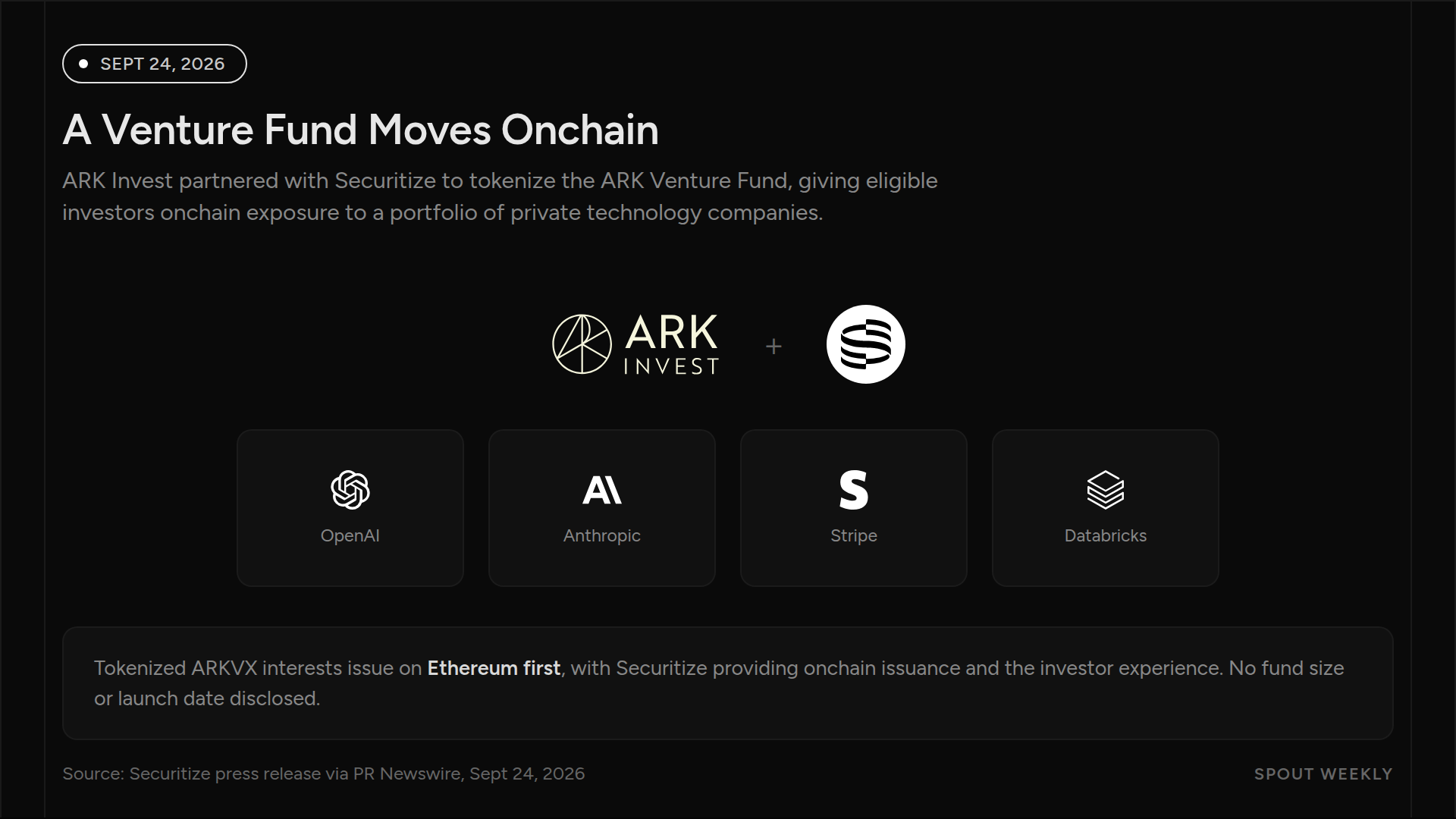
ARK Invest partnered with Securitize to tokenize the ARK Venture Fund, an actively managed closed-end interval fund with exposure to private and public technology companies including OpenAI, Anthropic, Stripe, and Databricks.
The tokenized ARKVX product will initially be available on Ethereum, with Securitize providing the infrastructure for onchain issuance and the investor experience, for eligible investors. (PR Newswire, September 24, 2026)
This is different from tokenizing an individual stock.
Instead of putting one security onchain, the product puts an entire investment strategy into an onchain format.
That opens another direction for tokenization.
The asset being moved onchain does not have to be a single company.
It can be a portfolio.
It can be a fund.
It can represent a strategy.
And once the product exists as an onchain instrument, it can potentially interact with wallets, exchanges, and other blockchain based financial applications within the restrictions attached to the product.
ARK’s move is therefore another example of established investment products being adapted to blockchain based distribution.
 Ondo takes portfolio strategies onchain
Ondo pushed the same idea further from another angle.
On September 24, Ondo launched Intelligent Portfolios, a set of three tokenized portfolio products based on nondiscretionary model portfolio strategies supplied by BlackRock to Ondo’s specifications.
The products are designed for eligible non-US investors in permitted jurisdictions and are issued as transferable onchain portfolio tokens.
The tokens automatically rebalance at the smart contract level, while their constituents, weights, and rebalances are visible onchain. (PR Newswire, September 24, 2026)
The BlackRock relationship needs an important qualifier.
BlackRock supplied the model strategies under a nondiscretionary licensing arrangement. It does not select, endorse, recommend, or manage the resulting products, and it has no ongoing obligation to update the strategies after their initial delivery.
So this is not an actively managed BlackRock partnership.
It is a licensed strategy arrangement that Ondo is packaging into an onchain product.
That distinction matters because the product demonstrates something broader.
Tokenization is moving beyond individual assets toward financial products that combine multiple assets and strategies into a single transferable instrument.
Dinari keeps building out its institutional push
Dinari added to the week’s institutional story too, in two steps.
On September 24, Dinari announced it had hired three business development leads, Umair Dandia, Vera Wang, and Isha Varshney, to scale institutional adoption of its tokenized equities. (PR Newswire, September 24, 2026)
A day later, on September 25, Dinari said it plans to bring its dShares tokenized equities, the S&P 500 lineup specifically in this rollout, to the Sei blockchain for eligible US investors, funded and settled in USDC through self custody wallets. This is a stated plan, not a live integration, and no timeline has been given.
The pattern fits the rest of the week. Tokenized equity issuers are not only adding assets. They are adding people, adding chains, and adding distribution surface, one piece at a time.
Tokenized equities are also becoming collateral
The biggest development for financial utility this week came from Aave.
On September 25, Aave V4 launched an Equities Hub on Base that allows eligible non-US users to borrow USDC against seven Coinbase-issued tokenized US equities.
The assets are AAPLc, AMZNc, GOOGLc, METAc, MSFTc, NVDAc, and TSLAc.
The stocks are collateral only at launch, while USDC is the borrowable asset. Chainlink provides the pricing infrastructure. (The Block, September 25, 2026, independently confirmed on Aave’s own governance forum)
The initial market parameters included roughly $29.3 million in aggregate collateral capacity, a $32 million USDC supply cap, and a $21 million USDC borrow cap.
Collateral factors range from 65% to 79% depending on the stock.
This is a meaningful shift in how tokenized equities can function.
A tokenized stock is no longer limited to being something a user holds or trades.
It can support a loan.
That means the asset becomes part of a broader financial transaction.
And that is where tokenization starts connecting directly with DeFi.
Aave’s launch changes the competitive landscape
The Aave Equities Hub is particularly relevant because it is one of the clearest live examples of tokenized equities being used as collateral.
But the structure is different from what Spout is building.
Aave’s market is a variable rate lending pool on Base, with USDC borrowing against Coinbase issued tokenized stocks.
Spout is building around tokenized equities as collateral while connecting lender returns to a covered call strategy.
The two models therefore use the same basic asset utility but approach lending and yield differently.
That distinction will become more important as more tokenized equities enter lending markets.
The market will have to compare not only which assets are supported, but how collateral is priced, how much users can borrow, how liquidation works, where lender yield comes from, and what risks sit underneath the return.
The important shift is that tokenized equities are starting to have financial functions beyond trading.
Ethena adds tokenized stocks to its collateral strategy
Ethena introduced another use case this week.
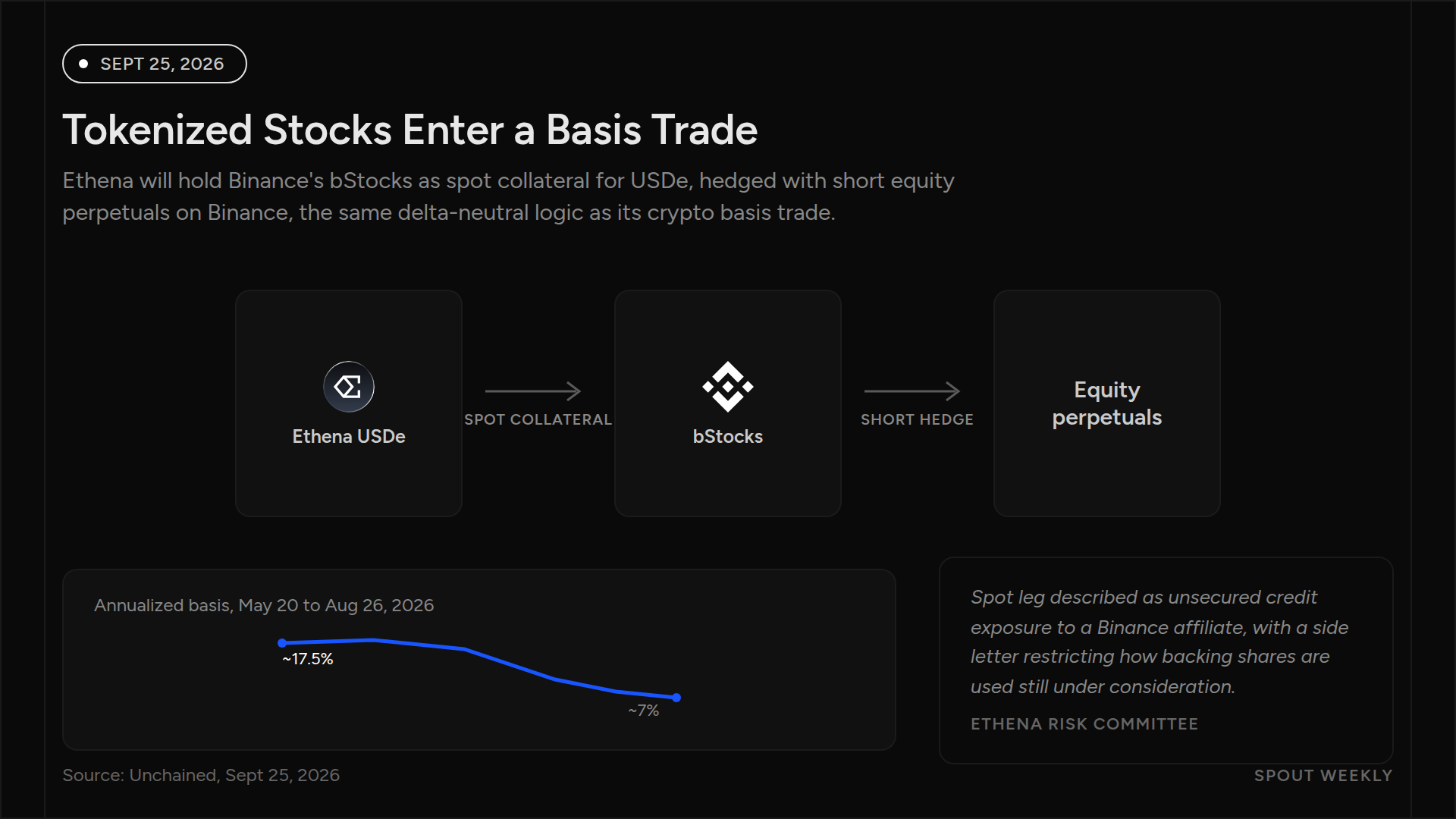
On September 25, Ethena said it will hold Binance’s bStocks as spot collateral for USDe while hedging the equity exposure with short equity perpetual futures on Binance.
The structure follows the same broad delta neutral logic used in Ethena’s existing basis trade model, but applies it to tokenized equities.
There is also an important risk consideration.
Ethena’s Risk Committee described the spot position as unsecured credit exposure to a Binance affiliate and said additional protections were being considered around how the backing shares are used. (Unchained, September 25, 2026)
The yield history also needs context.
The new equity perpetual strategy averaged approximately 17.5% annualized from May 20 to August 11, 2026, before narrowing toward roughly 7% by late August.
That is separate from Ethena’s earlier Bitcoin basis trade figures.
The broader takeaway is that tokenized equities are becoming inputs into increasingly complex financial strategies.
They are not only assets to buy and sell.
They can become collateral, trading inventory, or part of a structured position.
 Regulators are still working through the open questions
The SEC’s September 17 Innovation Exemption cleared the way for the kind of trading and lending activity described above, but this week showed how much of that framework is still unsettled.
Securitize president Carlos Domingo published an analysis on September 23 noting the exemption does not require independent audits, qualified custodians, transfer agent verification, or proof of reserves for the tokenized securities venues it covers, an open gap the SEC itself appears to be soliciting comment on. The exemption’s other mechanics are more specific: permissioned venues must run on public smart contracts on permissionless ledgers, must halt trading when the underlying stock halts, and face volume caps tied to prior month trading averages. (CryptoTimes, September 24, 2026, summarizing Domingo’s September 23 statement)
Separately, on September 23, the SEC Crypto Task Force’s chief counsel said some tokenized securities venues could begin filing operational frameworks under the exemption as early as the fourth quarter of 2026, with a lag likely before filings actually arrive. (Blockzeit, September 23, 2026)
Whether custody, audit, and proof of reserves requirements get added before venues start operating at scale is an open regulatory question. It is not one the market, or Spout, has an answer to yet. Worth watching, not predicting.
The market is getting broader, but demand is still the open question
Put together, this week’s developments show two things happening at once.
The number of products built around tokenized assets is increasing.
But the market is still trying to prove that users want those products at scale.
OKX’s tokenized lineup keeps growing inside its app.
ARK is putting a venture fund onchain.
Ondo is putting portfolio strategies into transferable tokens.
Dinari is adding people and adding chains.
Aave is turning tokenized equities into collateral.
Ethena is using tokenized stocks inside a synthetic dollar strategy.
And Robinhood is approaching a test of whether its current trading activity holds once subsidies change.
At the same time, TD Securities is pointing to the current gap between tokenized stock activity and traditional equity markets, and regulators are still filling in the framework underneath all of it.
That tension is likely to define the next stage of the market.
More products are arriving.
Now they need to prove their utility.
Solana’s tokenized equity market keeps expanding
Solana’s tokenized equity market also reached another milestone this week.
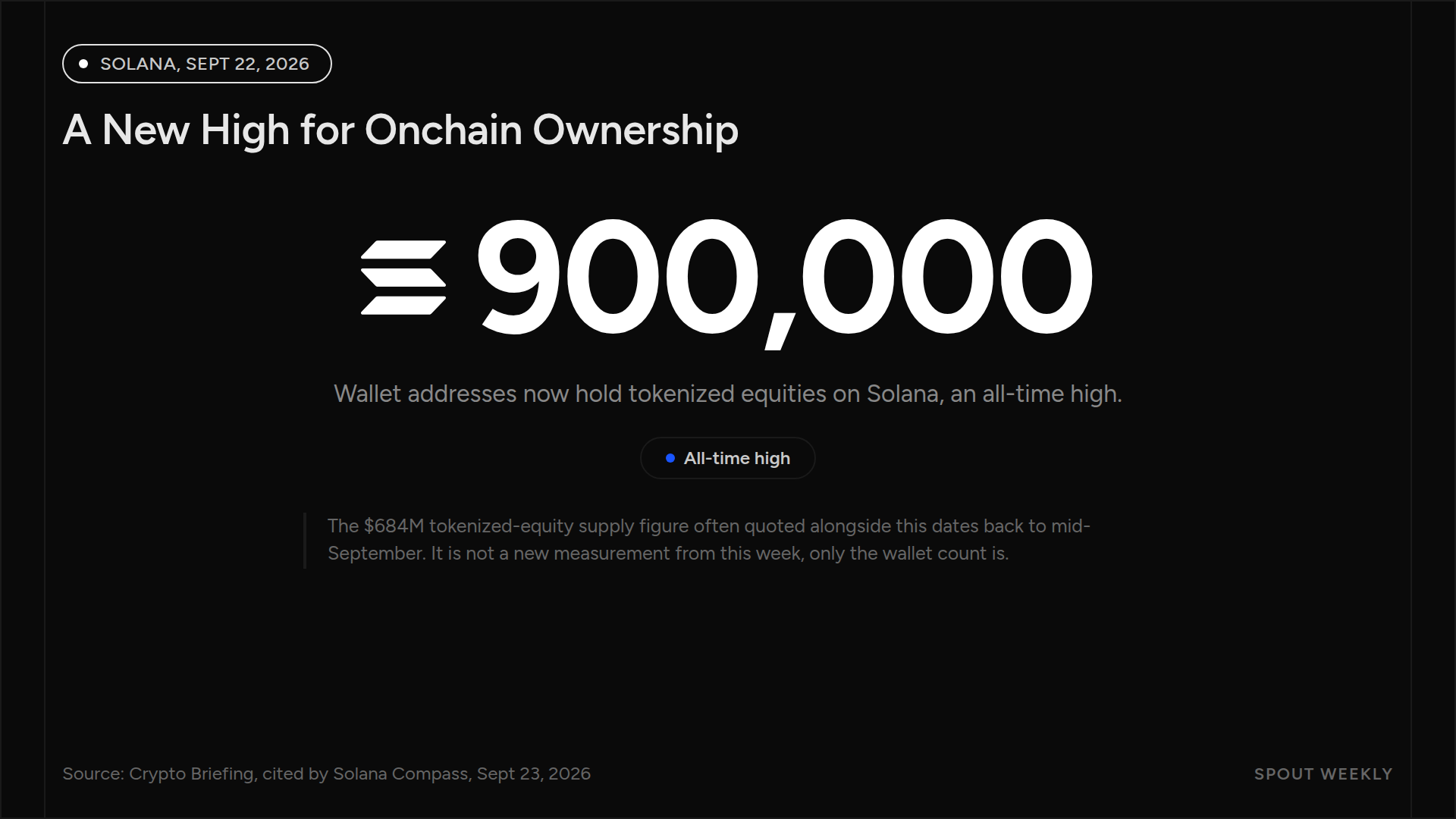
On September 22, the number of wallet addresses holding tokenized equities on Solana crossed 900,000, reaching an all time high. The figure was reported by Crypto Briefing and cited by Solana Compass. (Solana Compass, September 23, 2026)
The holder count is the important new data point.
The $684 million tokenized equity supply figure often mentioned alongside it dates back to mid September and should not be treated as a new September 22 measurement.
Still, 900,000 wallet addresses holding tokenized equities represents a significant distribution milestone.
It suggests tokenized equities are reaching a wider onchain user base even as questions remain around actual trading demand.
That distinction is worth keeping in view.
Ownership or wallet distribution tells us how widely an asset is held.
Trading volume tells us how actively it is being used.
Lending activity tells us whether it can serve another financial function.
The market needs all three to understand where tokenized equities are actually gaining traction.
 Solana’s wider RWA market reaches $4.6 billion
On September 23, Solana’s broader RWA market reached approximately $4.6 billion across all asset categories, according to KuCoin News Flash.
The figure covers more than tokenized equities, with Circle, Tether, and BitGo leading by volume.
The same report put the number of wallets holding RWA instruments at 685,850.
That distinction matters because the $4.6 billion figure should not be read as tokenized equity value.
It represents the wider RWA market on Solana.
But it reinforces the broader role Solana is developing in tokenized financial assets.
Equities are one part of the market.
Stablecoins, funds, credit products, and other real world assets make up the rest.
As more of those categories develop on the same network, the opportunity becomes less about one isolated tokenized asset and more about the financial applications that can connect them.
NYSE and Blockchain.com look toward tokenized stocks
Another major distribution development came from Blockchain.com and the New York Stock Exchange.
On September 23, the two companies signed a memorandum of understanding that could give Blockchain.com users future access to tokenized US exchange listed stocks and ETFs through the NYSE’s planned digital alternative trading system.
The arrangement also includes a data sharing component involving ICE Data Services and Blockchain.com. (The Block, September 23, 2026)
The product is not live yet.
It depends on the NYSE’s digital ATS launching and receiving the necessary regulatory approvals, and no launch date or stock list has been announced.
That makes this a future distribution channel rather than current market activity.
But it points to another possible direction for tokenized equities.
Traditional exchanges do not necessarily have to be replaced by blockchain markets.
They can also become part of the infrastructure through which tokenized versions of traditional assets are distributed.
The next Solana upgrade is getting closer, but the timeline needs context
Solana’s Alpenglow upgrade also progressed this week.
The upgrade completed its testnet transition and reached devnet on September 26, activating at epoch 1167 after a 17 minute countdown. (CoinDesk, September 26, 2026)
There is still no announced mainnet beta activation date.
That clarification matters because several dates circulating online had been incorrectly associated with Alpenglow.
September 28 refers to an Agave v4.3 feature activation milestone, not an Alpenglow mainnet activation date.
The November 9 date belongs to Agave v4.4’s general feature activation schedule and is also unrelated to an Alpenglow mainnet launch. (Solana Compass, September 21 and 22, 2026)
The actual development this week is that Alpenglow has moved through another public testing stage.
For financial applications, faster settlement remains relevant because more complex onchain financial products require infrastructure that can handle frequent pricing, collateral, and transaction updates.
But the mainnet date remains open.
Solana is also building around tokenized finance at the organizational level
The Solana Foundation made two leadership appointments this week that fit directly into its broader push toward institutional and tokenized finance.
On September 24, the foundation named Rachel Conlan, formerly Binance’s chief marketing officer, as Chief Strategy Officer and Jamal Raees, a Polygon veteran, as General Manager of Payments. (CoinDesk; Solana Foundation press release, September 24, 2026)
The appointments were framed around expanding Solana’s work across institutional finance, payments, and tokenized financial products.
That is not a product launch or a new tokenized asset.
It is a signal about where the ecosystem is putting organizational resources.
For Solana, tokenized finance is increasingly being treated as a broader market category rather than a single application type.
Backpack has a much bigger target for Solana
Backpack added another ambitious signal on September 26.
CEO Armani Ferrante said the company wants to expand from roughly 200 currently supported tokenized stock symbols to 10,000. (crypto.news, September 26, 2026)
No launch date was provided.
The statement is therefore an ambition rather than a product release.
But the scale of the target is notable.
Moving from hundreds of supported stocks toward a representation of the broader stock market would change the potential distribution of tokenized equities on Solana.
It would also increase the importance of everything built around those assets.
More assets mean more potential markets.
More markets mean more demand for trading, custody, lending, collateral management, pricing, and settlement infrastructure.
The value of the expansion will ultimately depend on how much users do with those assets.
xStocks shows how distributed tokenized equities have become
On September 25, xStocks reported $848.1 million in tokenized assets across eight blockchains. (Gokhshtein Media, September 25, 2026)
Solana accounted for $502.4 million, or 58.5% of the reported total, followed by X Layer and Ethereum.
This is an issuance and distribution figure.
It is not a measure of lending, borrowing, or trading activity.
That distinction is important when comparing tokenized equity ecosystems.
A large supply tells us how much of an asset has been issued or distributed.
It does not automatically tell us how actively the asset is being used.
Still, the distribution figures show that Solana remains a major venue for tokenized equity activity.
The oracle transition exposes an infrastructure challenge
The week also brought a more difficult Solana infrastructure story.
September 25 marked the six day migration deadline following Switchboard’s announcement that it would shut down its oracle service.
Protocols including Kamino, Jito, MarginFi, and Drift had been identified as users of Switchboard feeds and were given a short window to migrate to alternatives such as Pyth Network or RedStone.
A September 25 investigation found that MarginFi had already deployed nine new non Switchboard oracle setups, while the status of Kamino’s exposure was harder to verify because it uses the Scope aggregator. Jito’s documentation still referenced Switchboard and appeared outdated. (crypto.news, September 25, 2026)
No losses or exploit were confirmed.
That distinction is important.
The event was an infrastructure migration issue, not a confirmed failure of a lending protocol.
But it highlights something increasingly important for RWA markets.
Tokenized equities depend on reliable price data.
Lending protocols need those prices to determine collateral values.
Liquidation systems need them to determine when positions fall below required thresholds.
And the underlying equities trade in traditional markets that may be closed while their tokenized representations remain active onchain.
As more tokenized stocks become collateral, oracle resilience becomes part of the financial product itself.
The macro picture is changing too
The yield environment shifted slightly this week even without a Federal Reserve meeting.
Three month Treasury bill rates moved from 4.11% on September 22 to 4.18% on September 24. (Treasury.gov, Daily Treasury Bill Rates)
That is a modest increase from last week’s reading and reflects movement in the bill market rather than a new Fed policy decision.
Onchain rates moved in a different direction.
Aave’s Ethereum V3 USDC supply APR was around 3.54% on September 26, down from approximately 3.60% last week. (Aavescan, read September 26, 2026)
Sky’s savings rate remained at 3.60%. (sky.money, read September 26, 2026)
Maple’s syrupUSDC supply APY rose to approximately 5.17%, up from 5.07% last week. (Aavescan; DefiLlama, read September 26, 2026)
The current Aave USDC rate therefore sits roughly 60 to 64 basis points below the three month Treasury bill.
Sky is around 54 to 58 basis points below it.
Maple remains above the Treasury benchmark.
The comparison shows why yield sources matter.
A Treasury bill produces its return through government debt.
Stablecoin lending produces returns through lending demand and protocol specific mechanisms.
Structured products can generate additional return through strategies that introduce additional risks.
For users, the APY alone does not explain the product.
The mechanism behind the yield matters just as much.
Solana’s spot ETFs had another strong week
Solana spot ETF flows were positive across every trading day from September 21 through September 25. (Farside Investors)
Farside’s reported daily flows were:
- September 21: +$26.0 million
- September 22: +$28.9 million
- September 23: +$13.7 million
- September 24: +$32.8 million
- September 25: +$86.7 million
That adds up to approximately $188.1 million in net weekly inflows.
September 25 was the largest day, driven primarily by Bitwise’s BSOL.
ETF flows do not directly measure tokenized equity adoption.
But they are another signal of institutional and traditional market access developing around Solana.
The broader ecosystem is therefore seeing activity across multiple financial layers at once.
TVL continues to grow across major lending protocols
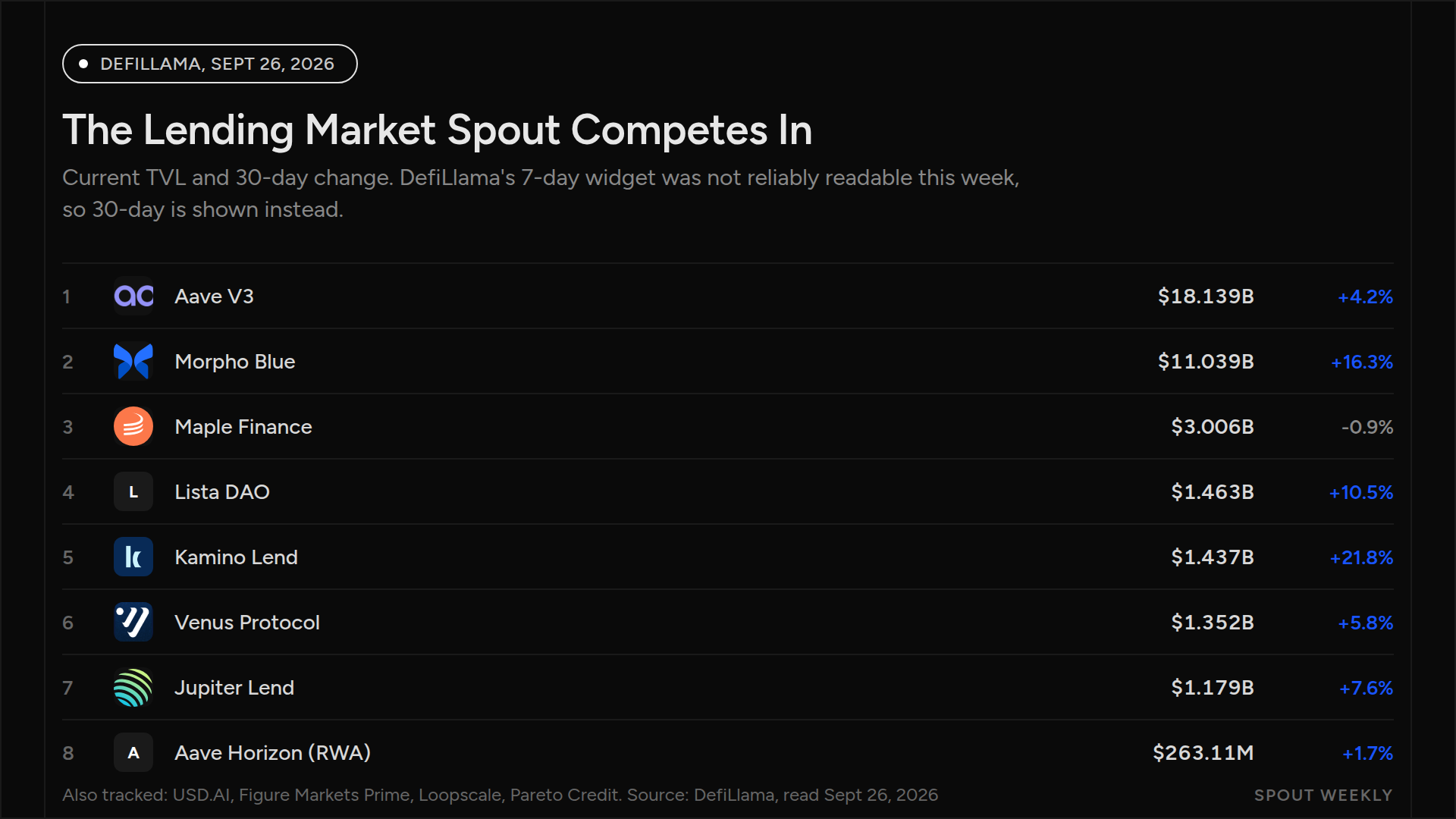
The September 26 DefiLlama snapshot also shows continued growth across several lending protocols over the past 30 days.
- Aave V3: $18.139B TVL, +4.2% over 30 days
- Morpho Blue: $11.039B TVL, +16.3%
- Maple Finance: $3.006B TVL, -0.9%
- Lista DAO: $1.463B TVL, +10.5%
- Kamino Lend: $1.437B TVL, +21.8%
- Venus Protocol: $1.352B TVL, +5.8%
- Jupiter Lend: $1.179B TVL, +7.6%
- Aave Horizon: $263.11M TVL, +1.7%
- USD.AI: $213.39M TVL, +22.8%
- Figure Markets, combined: $355.46M TVL, -9.1%
- Figure Markets Democratized Prime: $192.15M TVL, -22.4%
- Loopscale: $75.49M TVL, -19.5%
- Pareto Credit: $160,061.51 TVL, +4.5%
The figures are current snapshots rather than weekly closing values because DefiLlama’s seven day change widget was not reliably accessible.
That makes the 30 day comparison more useful for identifying broader direction than for measuring what happened specifically between September 20 and 26.
The main pattern is continued scale across major lending markets, with Kamino and Morpho showing particularly strong 30 day growth in this snapshot.
 Spout Finance sits directly inside this shift toward utility
This week’s developments make one thing increasingly clear.
The tokenized equity market is moving beyond the question of whether stocks can exist onchain.
The harder question is what those assets can actually do.
Aave answered that question this week by allowing seven Coinbase issued tokenized stocks to serve as collateral for USDC borrowing.
Ethena is using tokenized stocks as part of a delta neutral synthetic dollar strategy.
Ondo is packaging portfolio strategies into transferable onchain tokens.
ARK is bringing a venture fund onto Ethereum.
Dinari is adding institutional distribution surface, one hire and one chain at a time.
OKX keeps growing its tokenized stock lineup inside its own app.
And Solana continues to see more tokenized equity holders, broader RWA activity, and new distribution ambitions.
This creates a larger market around the asset itself.
For Spout, that is the layer that matters.
A tokenized equity can be more than something users hold.
It can become collateral.
A user can borrow stablecoins against the position instead of selling the underlying equity.
That creates another way to access liquidity while maintaining exposure to the asset.
But utility needs to come with clear mechanics
The Aave launch also makes the expectations around collateralized tokenized equities clearer.
Users need to know:
How much can they borrow?
What determines the collateral value?
What happens when the stock price falls?
How are liquidations handled?
Where does the lender yield come from?
What happens when the traditional market is closed?
And which oracle provides the price?
These are not secondary details.
They are part of the product.
The Switchboard migration this week reinforces the same point from the infrastructure side.
When tokenized assets become collateral, the systems underneath them become part of the financial risk.
Spout’s model therefore has to be understood through both sides of the product.
The user gets access to stablecoin liquidity against a tokenized equity.
The lender receives yield generated through covered call premiums written against the collateral.
Neither side exists independently of the underlying mechanics.
The market is becoming more competitive
The developments this week also create a clearer competitive landscape.
Aave now has a live tokenized equity collateral market on Base.
Ethena is incorporating Binance’s bStocks into its USDe collateral strategy.
Ondo is expanding tokenized products from individual stocks into portfolio strategies.
Dinari is expanding its institutional distribution across people and chains.
Backpack wants to scale tokenized stock coverage dramatically on Solana.
OKX keeps its tokenized stock lineup growing inside a major trading application.
xStocks reported hundreds of millions of dollars in tokenized assets across multiple chains.
None of these products are identical.
That is important.
They are competing for different parts of the same emerging financial stack.
Some focus on distribution.
Some focus on trading.
Some focus on lending.
Some focus on structured products.
Some focus on portfolio construction.
The market is beginning to separate into different layers rather than one single tokenized stock category.
The bigger question is whether users stay
That brings us back to the skepticism around demand.
TD Securities’ 99.9% traditional volume figure shows how far tokenized stocks still have to go relative to conventional equity markets.
Robinhood’s upcoming fee subsidy expiry creates another real world test.
And the growing number of products creates more competition for user attention.
The market therefore has two jobs ahead.
First, make tokenized assets easier to access.
Second, give users reasons to keep using them.
Trading alone may not be enough.
The stronger opportunity comes when the same asset can move through multiple financial applications.
It can be held.
It can trade.
It can become collateral.
It can support borrowing.
It can interact with stablecoin liquidity.
It can sit inside a portfolio.
It can become part of a structured strategy.
That is where tokenization starts becoming financial utility rather than simply a new format for ownership.
The next layer is being built now
This week’s market did not produce one single story.
It produced a collection of signals pointing in the same direction.
Tokenized stocks are reaching more trading platforms.
Funds and portfolio strategies are moving onchain.
Tokenized equities are becoming collateral.
Institutional investors are experimenting with onchain distribution.
Solana’s tokenized equity holder base reached a new high.
RWA value across Solana reached $4.6 billion.
Infrastructure is being upgraded, tested, and, in some cases, replaced.
Regulators are still filling in the framework underneath all of it.
At the same time, demand remains the biggest unanswered question.
The market is getting better at creating tokenized financial products.
Now it needs to show that users want to use them.
For Spout Finance, that is where the opportunity sits.
The asset is already being brought onchain.
The next layer is giving that asset more financial utility.
And as tokenized equities become more widely distributed across Solana and beyond, the products that connect those assets to liquidity, borrowing, and yield will become an increasingly important part of the market.