Weekly Roundup: Tokenized Stocks Get Their Biggest Regulatory Signal Yet
Market & Insights
September 19, 2026
Tokenized stocks are becoming more usable. This week brought a new SEC framework for certain onchain trading venues, wider access to securities infrastructure on Solana, increased borrowing against tokenized equities, and deeper links between RWA, DeFi, and TradFi. The bigger story is what these assets can do once they are onchain.

The RWA market had a different kind of week.
Instead of another wave of tokenized assets being announced, the focus shifted toward the rules, infrastructure, and financial products forming around them.
The biggest development came from the SEC, which issued a temporary Innovation Exemption for certain venues trading tokenized US stocks onchain. At the same time, tokenized equities became easier for Solana developers to issue and redeem, institutional market infrastructure moved closer to tokenized funds, and lending markets started showing real borrowing activity against tokenized stocks.
The result is a market beginning to move from experimentation toward a more defined financial structure.
The SEC opens a path for tokenized stock trading
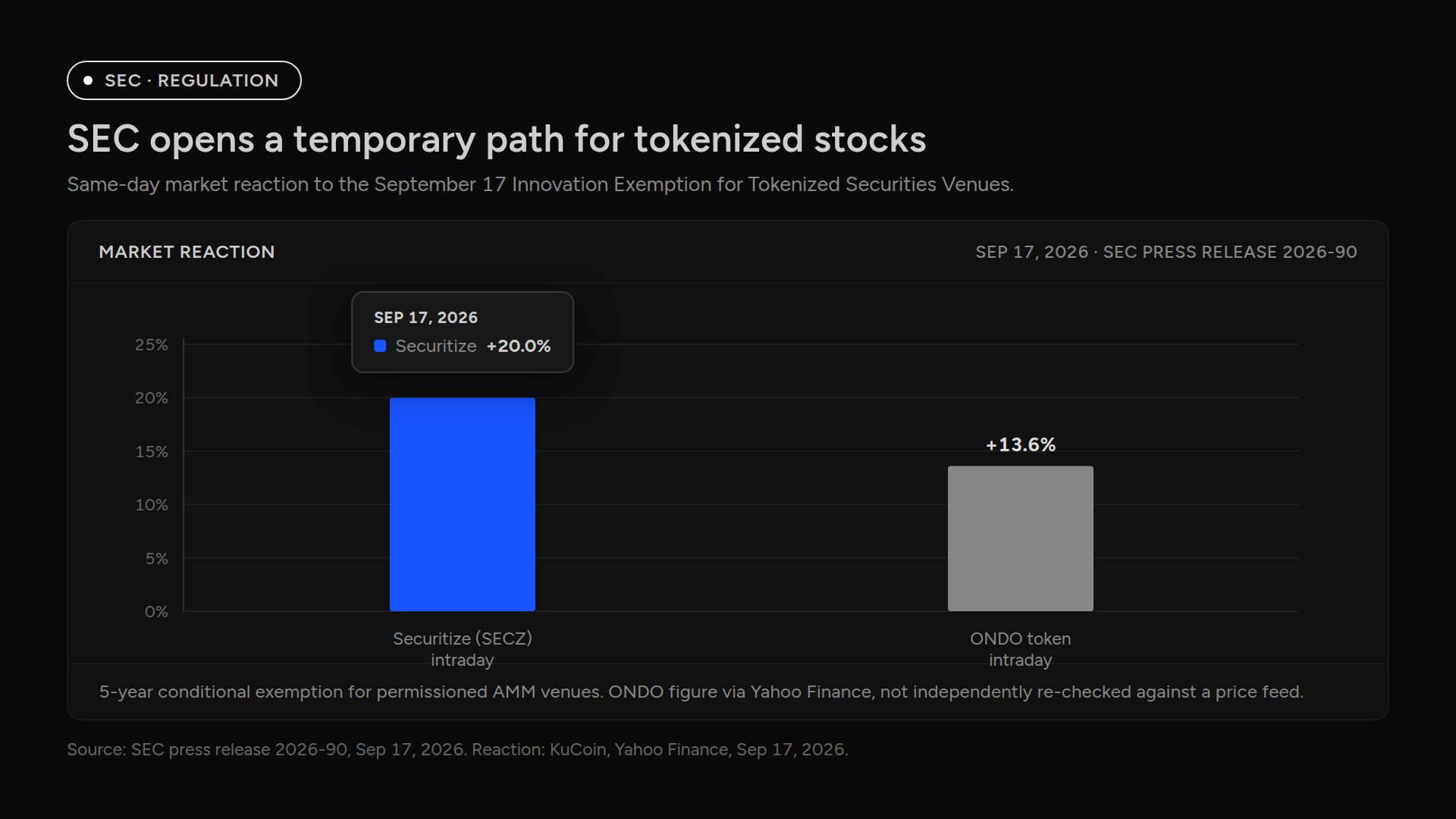
The headline event came on September 17, when the SEC issued a five-year conditional exemption covering certain Tokenized Securities Venues trading tokenized National Market System stocks through permissioned automated market makers and liquidity pools. (SEC)
The exemption also provides parallel relief from dealer registration for liquidity providers participating in those pools.
There are several conditions attached.
The tokenized securities must carry the same rights as the corresponding traditional stocks, including voting and dividend rights. The smart contracts must be public and auditable, while the underlying ledger must be permissionless. Trading halts also need to remain synchronized with the primary market for the underlying stock.
The exemption gives issuers a 30-day window to object before an unaffiliated third party can tokenize their stock.
Synthetic and derivative representations are excluded from the relief.
That last point creates an important distinction within the tokenized-equity market. Not every product described as a tokenized stock represents the same legal or economic claim. Some models are built around direct ownership or securities entitlements, while others provide synthetic exposure.
The SEC’s action does not settle every question around tokenized securities. It is temporary, conditional relief, with a public comment period and a stated role as a bridge toward longer-term rulemaking. (SEC)
The market reaction was immediate. Securitize’s stock surged more than 20% intraday, the ONDO token rose 13.6%, and Robinhood CEO Vlad Tenev posted that tokenization is coming to America. (KuCoin, Yahoo Finance, Benzinga)
 But it changes the conversation.
The question is no longer only whether tokenized stocks can exist.
There is now a defined regulatory framework for certain venues to experiment with how those stocks can trade onchain.
The timing makes the development even more significant
The SEC announcement arrived shortly after the Senate failed to advance the CLARITY Act on September 15.
That vote required 60 votes to advance the crypto market-structure bill. The bill did not clear the threshold, creating another period of uncertainty around broader US crypto market structure.
Two days later, the SEC introduced its temporary exemption for tokenized NMS stock trading.
The two events address different parts of the regulatory system, so they should not be treated as interchangeable. But they happened within the same week and created a notable contrast between legislative uncertainty and a regulator providing a specific temporary pathway for one part of the tokenization market.
For tokenized-equity builders, that distinction matters.
A temporary exemption is not the same thing as permanent regulation.
It does, however, give eligible market participants a framework they can build around while the longer-term rules develop.
Tokenized equities are becoming easier to build with
Another important development came from Backpack Securities.
On September 13, Backpack opened its mint and redeem API to all Solana developers.
Previously, the infrastructure was primarily available within Backpack’s own products. The change means developers building on Solana can use a single API to mint or redeem tokenized securities tied to underlying security entitlements. Backpack’s securities are structured as UCC Article 8 entitlements under New York law and are designed to be redeemable 1:1 for the underlying shares. (Solana Compass)
That is a meaningful change in the developer layer.
Instead of every application having to build its own path between traditional securities and onchain representations, an existing securities infrastructure can become something other Solana applications build on top of.
Access is expanding on the distribution side too. Dinari’s tokenized equities went live inside Bitcoin.com Wallet for US users this week, giving another retail wallet a turnkey way to offer tokenized stocks without building that infrastructure itself. (Bitcoin.com)
This is the kind of development that can increase the number of applications around tokenized equities without requiring every team to recreate the issuance and redemption stack.
And that matters because the next phase of tokenization is unlikely to be defined by a small number of standalone platforms.
It will be defined by how many applications can actually use the assets.
Lending is starting to show what that utility looks like
The lending side of the market provided another example this week.
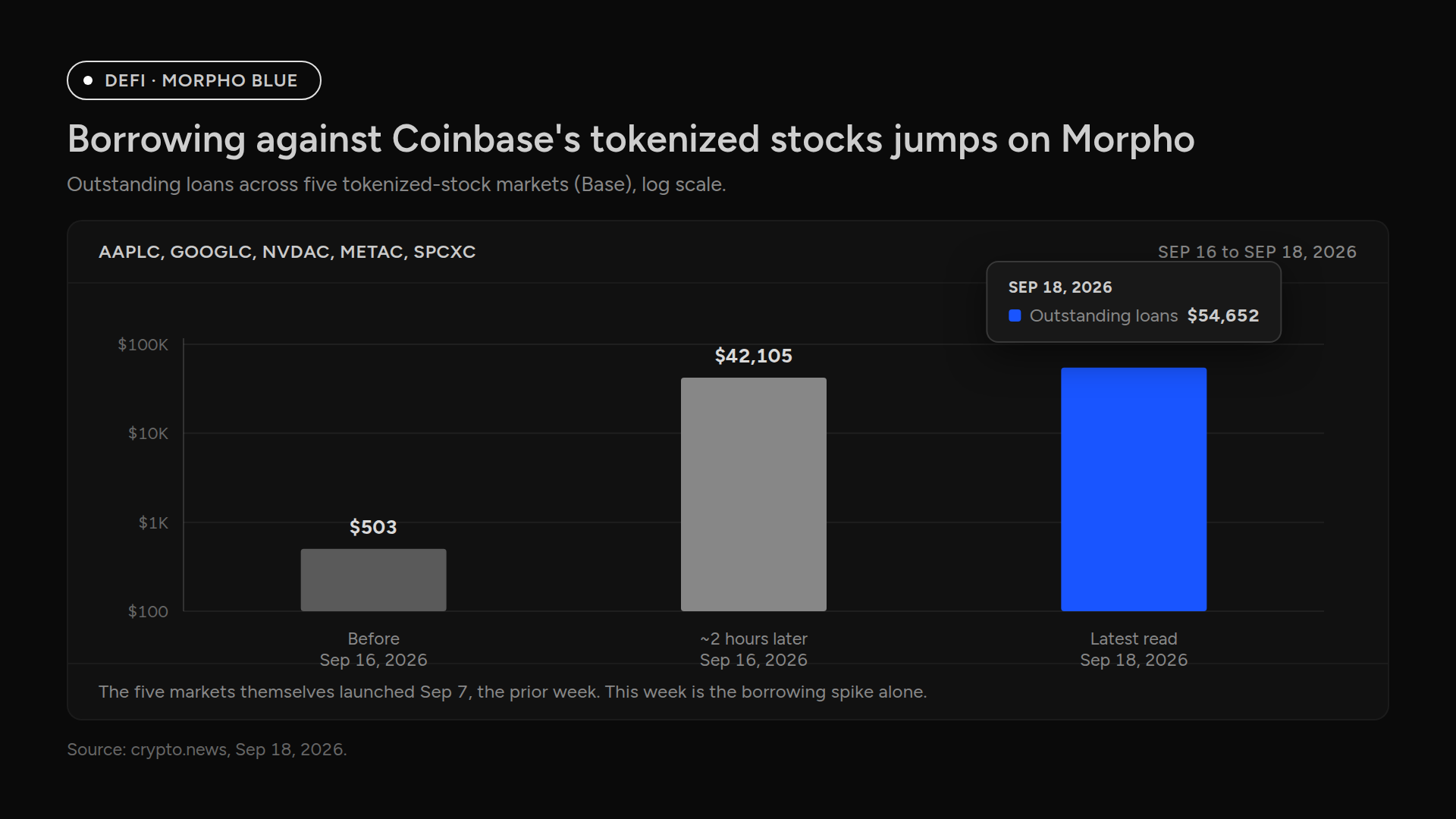
Borrowing against Coinbase’s tokenized stocks on Morpho Blue jumped sharply on September 16.
The five markets covering AAPLc, GOOGLc, NVDAc, METAc, and SPCXc had around $503 in outstanding loans before the move. That figure reached $42,105 within roughly two hours and climbed to $54,652 by September 18.
The markets themselves were launched the previous week, so the launch is not new information for this roundup.
The new development is the borrowing activity.
That distinction is important.
A tokenized stock existing onchain is one thing.
Someone actually using it as collateral to borrow stablecoins is another.
The latter starts showing the financial utility that tokenization is supposed to create.
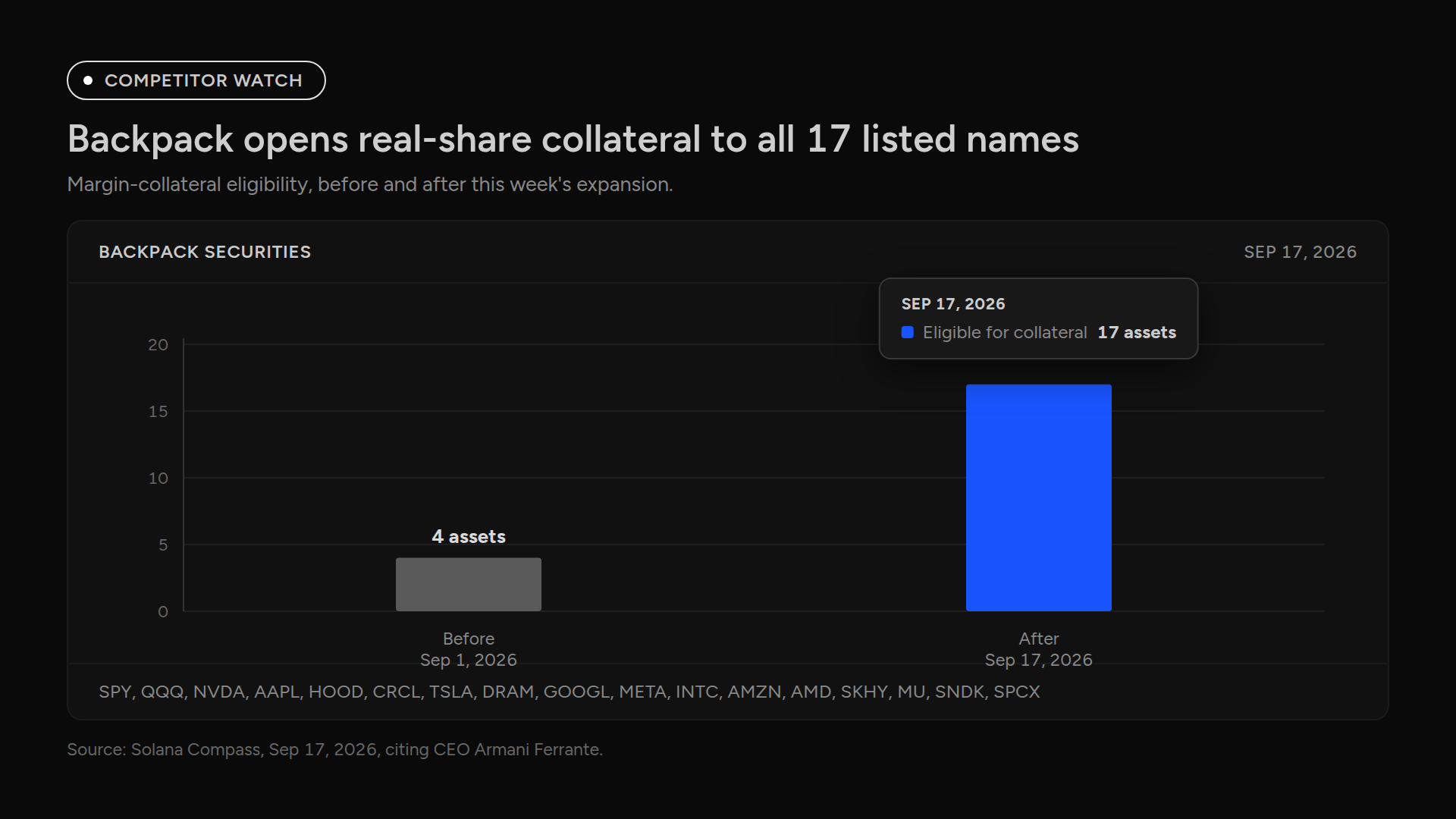
 Backpack Securities moved in the same direction from a different angle. On September 17, Backpack expanded margin-collateral eligibility from 4 of its listed stocks and ETFs to all 17. Real shares held as broker entitlements, not tokenized ones, can now be used to borrow USD, trade spot on margin, or back perpetual futures across the full list. (Solana Compass)
 The same direction appeared in Kamino’s expansion this week.
Kamino named tokenized equities from Forward Industries and Galaxy among the assets listed as collateral on its platform as it announced Michael Weisz as CEO and opened a New York headquarters for its US and institutional expansion.
Kamino also claimed its PRIME market had grown to more than $600 million in deposits within 107 days of launch. That figure should be treated as Kamino’s own claim because the launch timing we could independently locate does not reconcile with the 107-day figure.
Aave signaled it wants to move in the same direction. The protocol announced plans for an RWA Hub on Avalanche V4 that would let eligible tokenized financial assets serve as collateral for stablecoin borrowing backed by Tether’s USAT. No qualifying assets, loan terms, or launch date have been disclosed, so this is a plan rather than a live product for now. (CryptoTimes)
The important development is the broader direction, not any single disputed timeline or unlaunched plan.
Tokenized equities are becoming part of lending markets, across more than one chain and more than one venue at once.
 Traditional market infrastructure is moving closer too
Ondo’s Oasis Pro Markets also joined DTCC’s Fund/SERV network this week.
Ondo described Oasis Pro as the first tokenization firm to join the network, which processes more than 85% of US mutual fund transaction activity according to the company’s announcement.
This is another example of tokenized assets moving closer to established financial infrastructure rather than operating completely outside it.
The significance is less about one membership announcement and more about the connection it creates.
Tokenized funds increasingly need to interact with the same operational systems used by traditional financial markets.
The closer those systems become, the less tokenization looks like a separate financial category and the more it starts looking like another format through which existing markets can operate.
Stablecoin infrastructure is expanding alongside tokenization
Circle’s Arc mainnet also went live this week.
Arc launched as a Layer 1 built around financial markets and real-time money movement, with more than 100 institutional and ecosystem builders involved at launch. Its founding validator group includes major financial institutions such as BlackRock, DTCC, ICE, Mastercard, Visa, and Standard Chartered. (Arc)
The network is not specifically an equity platform.
That is precisely why it matters here.
Tokenized securities need more than an asset layer. They need payment rails, settlement assets, and infrastructure that can move value between financial applications.
Arc is another example of companies building those rails specifically around programmable financial activity.
The same broader pattern is visible across the RWA market.
Tokenized assets are being connected to trading venues.
Trading venues are being connected to liquidity.
Liquidity is being connected to lending.
And stablecoins sit underneath many of those transactions.
The pieces are becoming increasingly interconnected.
The macro backdrop changed the economics of yield
The week also brought a major shift in rates.
The Federal Reserve raised its target federal funds rate by 25 basis points to 3.75%-4.00%, effective September 17. The decision was unanimous. (Reuters)
That pushed the three-month Treasury bill yield higher, reaching roughly 4.12% on a constant-maturity basis around September 17-18.
Meanwhile, several onchain lending rates remained below that benchmark.
Aave’s USDC supply rate was around 3.60%.
Sky’s savings rate was also around 3.60%.
Aave’s sUSDe market was around 4.72%.
Maple’s syrupUSDC was around 5.07%.
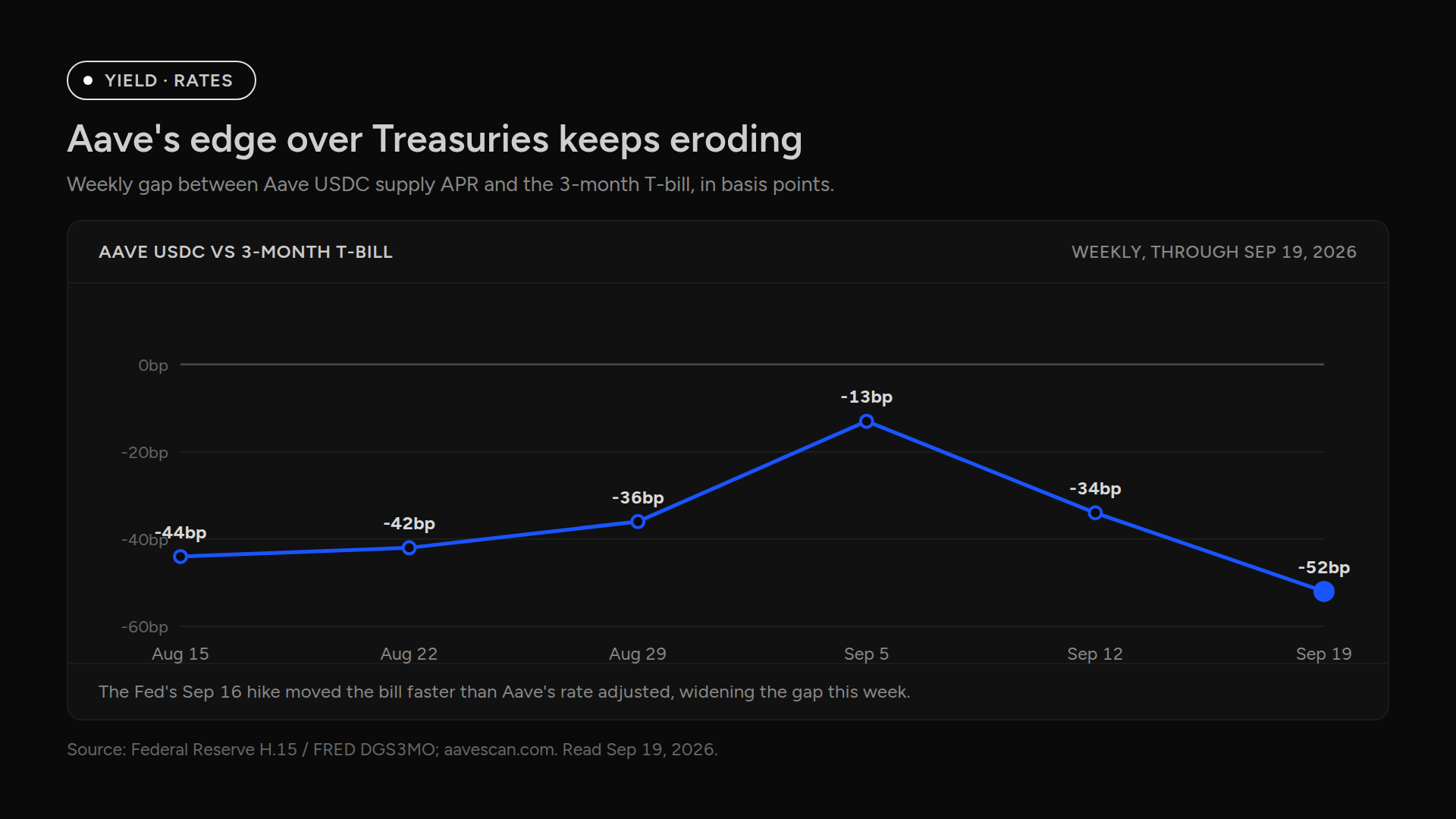 That creates a wider gap between traditional short-duration government yields and basic stablecoin lending.
For users, the comparison is becoming harder to ignore.
If a financial product offers yield above the Treasury benchmark, the question becomes what additional activity is generating the difference.
The yield needs to be understood alongside its collateral, strategy, and risk.
That matters even more for RWA products because the entire point of tokenization is to connect traditional assets with additional financial functionality.
The market is moving from issuance toward use
Taken together, this week’s developments show a market becoming more focused on what happens after an asset is tokenized.
The SEC created a temporary pathway for certain tokenized-stock trading venues.
Backpack opened its issuance and redemption infrastructure to Solana developers, and expanded which of its listed stocks can back a loan.
Morpho saw borrowing activity against tokenized equities.
Kamino expanded its institutional positioning around RWA collateral, and Aave signaled it wants to build a similar hub on Avalanche.
Ondo moved closer to established fund-market infrastructure.
Circle launched a new settlement-focused blockchain with major financial institutions involved.
And the Fed’s rate decision raised the benchmark that onchain yield products now have to compete against.
The common thread is no longer simply putting assets onchain.
It is making those assets usable.
That brings us to the next question: what is happening on the chain where a growing share of tokenized-equity activity is already taking place?
Solana is becoming a more active market for tokenized equities
The Solana side of the story was considerably more active this week.
Backpack opened its tokenized-securities mint and redeem API to all Solana developers, giving builders access to infrastructure that was previously limited to Backpack’s own products.
That makes Solana more than a place where tokenized stocks can trade.
It becomes a place where developers can build products around the assets themselves.
The activity is already showing up in trading volumes.
Raydium reported that it had processed more than $5 billion in cumulative tokenized-stock volume, while routing more than 90% of Solana’s tokenized-stock DEX volume.
That puts decentralized exchanges directly inside the tokenized-equity market rather than leaving trading entirely to centralized venues.
Solana’s spot ETFs had a calmer but still positive week alongside that activity, with net inflows totaling roughly $60.7 million across September 14 through 18. (Farside Investors)
The broader significance is the combination of issuance, trading, and financial applications happening on the same network.
A developer can access tokenized securities.
A user can trade them on a DEX.
Those assets can then move into lending markets.
That creates a much more complete financial environment around tokenized equities.
A more unusual development played out on a different chain entirely. genius.fun launched on BNB Chain this week as a launchpad where tokenized shares can be unwrapped and used to pursue activist campaigns or outright takeovers of real public companies, drawing on tokenized-equity brands including Solana’s own xStocks and bStocks as tradeable inputs. It sits outside Solana’s own ecosystem, but it is a novel use of tokenized-equity infrastructure worth watching. (Invezz)
Solana’s infrastructure is also changing
Transaction V1 went live on mainnet during the week, bringing a larger transaction format, cheaper program deployments, a 250ms slot target, and lower rent requirements.
The larger transaction envelope is particularly relevant for applications that need to pack more instructions and data into a single transaction.
For financial applications, that can matter.
Tokenized assets often involve more than a simple transfer. A transaction can involve collateral updates, pricing information, lending instructions, and other program interactions.
Reducing the friction around more complex transactions gives developers more room to build those flows directly into applications.
There is also a broader token infrastructure angle.
Token-2022 is moving toward the Pinocchio entrypoint, with transfer-hook support planned. Programmable token mechanics like these can become increasingly relevant as tokenized assets need rules around how they move, who can interact with them, and how applications respond to transfers.
The infrastructure is not the product by itself.
It is what allows the financial products built on top of it to become more sophisticated.
But the week also showed where the infrastructure still needs to mature
Not every development was positive.
Switchboard announced that it is shutting down, with support ending September 25.
Kamino, Jito, MarginFi, and Drift were among the Solana protocols identified as relying on Switchboard feeds and facing a short migration window. Pyth Network and RedStone were named as replacement options. (Solana Compass)
For a financial ecosystem, oracle infrastructure is critical.
Lending markets need accurate prices.
Collateral systems need reliable valuations.
Liquidations need to happen against trustworthy data.
Tokenized equities add another layer because the onchain asset represents an offchain market that operates according to traditional trading hours and market rules.
The Switchboard shutdown is therefore more than an isolated infrastructure story.
It is a reminder that financial applications need resilient data infrastructure underneath them.
That becomes especially relevant as more tokenized equities become collateral across Solana, including at Kamino, which is simultaneously trying to scale its RWA collateral business this same week.
This is where Spout’s position becomes clearer
The developments this week make the distinction between tokenization and financial utility even more important.
The market is getting better at putting stocks onchain.
The harder and more valuable layer is what happens after they arrive.
Spout is building around that layer.
A tokenized equity can represent ownership or exposure, but Spout is designed to give that asset another function.
It can become collateral.
A user can borrow stablecoins against the position instead of selling the underlying equity.
That changes the role of the tokenized stock.
It is no longer only an investment to buy and sell.
It becomes an asset that can be used to access capital.
That direction is becoming easier to see across the market this week.
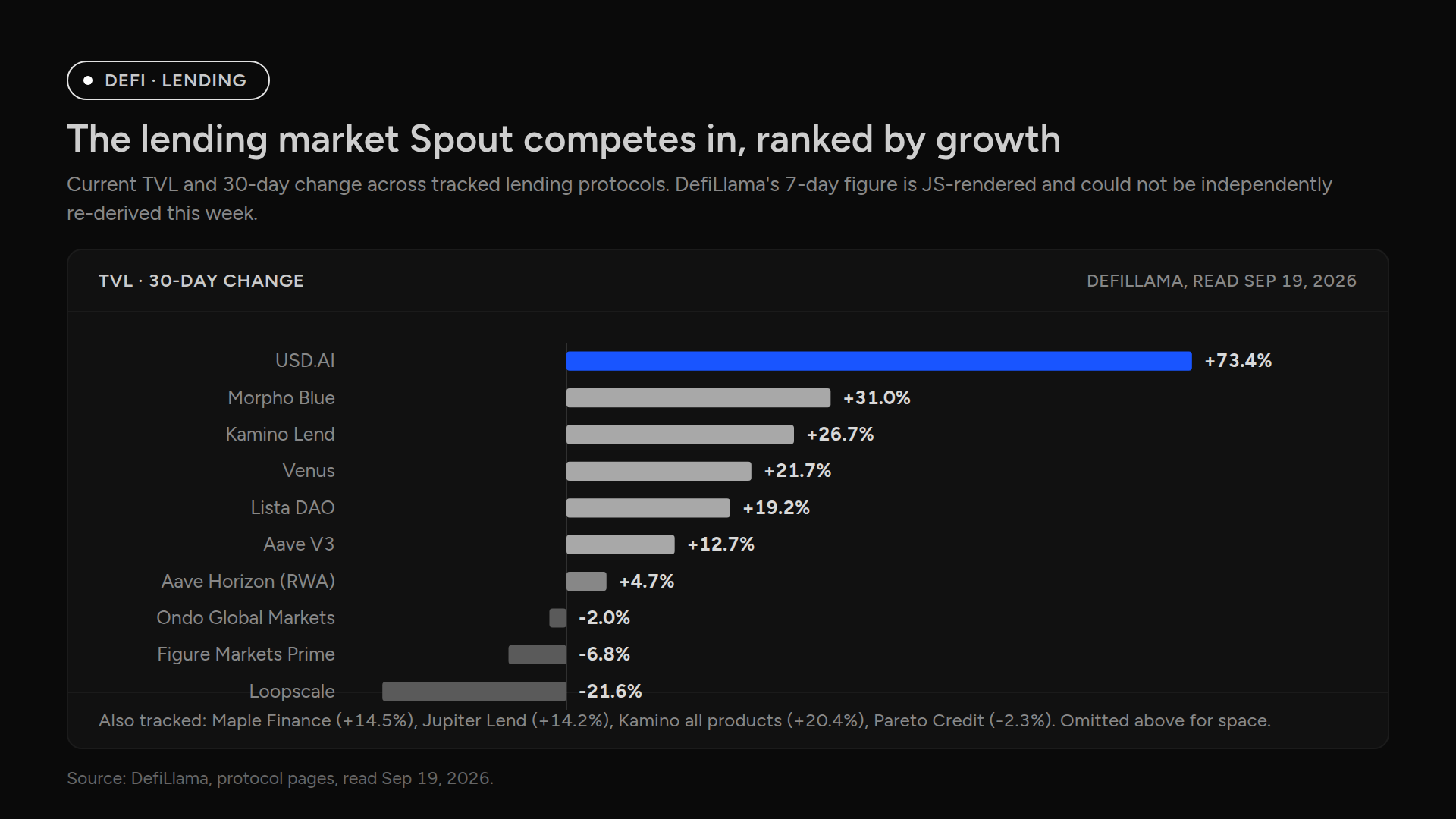
Morpho is showing borrowing activity against tokenized stocks.
Kamino is expanding its RWA collateral offering, and Aave wants to build something similar on Avalanche.
Backpack is opening its securities infrastructure to more developers, and letting more of its listed stocks back a loan.
And the SEC is creating a temporary framework for certain forms of onchain tokenized-stock trading.
Spout is operating in the layer between those developments.
For users, the difference is simple
The traditional relationship with a stock is straightforward.
Buy it.
Hold it.
Sell it.
A tokenized equity can support more actions.
Buy it.
Hold it.
Use it as collateral.
Borrow against it.
The user does not automatically have to sell the position to access capital.
That is the utility Spout is building around.
For someone who wants to maintain exposure to an equity while accessing stablecoin liquidity, collateralized borrowing creates another path.
It does not remove market risk.
The underlying equity can fall in value, which can affect collateral health and liquidation conditions. Pricing infrastructure also needs to work properly, especially when the underlying stock market is closed while onchain markets remain active.
Those mechanics matter.
The value of a lending product is not only the amount a user can borrow. It is also how reliably the system prices collateral, manages risk, and handles market conditions.
Yield is the other side of the system
Spout’s lending model also connects tokenized equities to a different part of the financial stack.
Lender yield comes from covered-call premiums written against collateral rather than token emissions.
That distinction becomes more relevant as Treasury yields move higher.
The three-month Treasury bill was around 4.12% this week.
Aave USDC was around 3.60%.
Sky’s savings rate was also around 3.60%.
Maple syrupUSDC was around 5.07%.
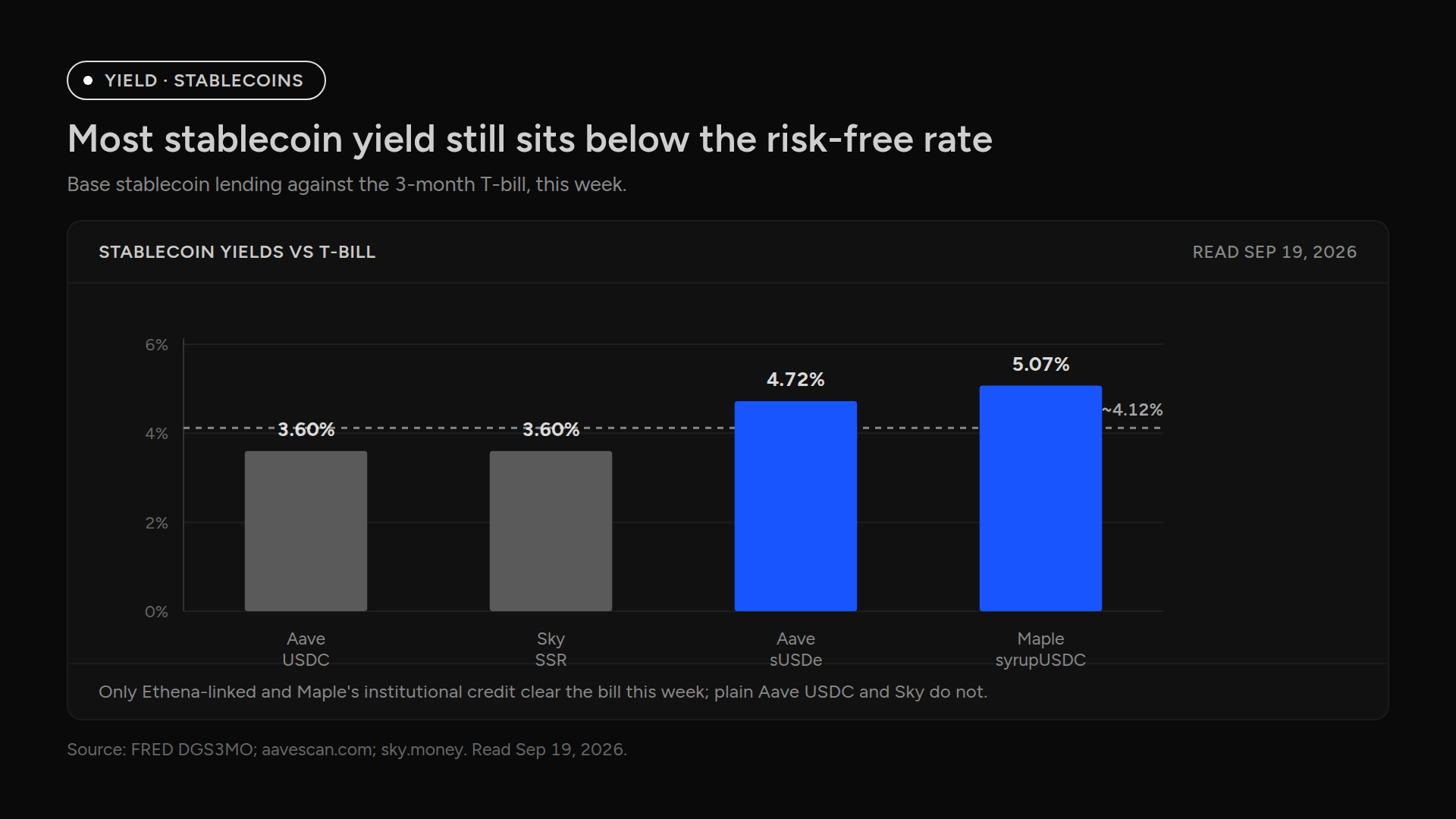 The spread between these products is not simply a question of which number is larger.
Each return comes from a different mechanism.
For Spout, the yield comes from an underlying options strategy connected to the collateral.
That means users need to understand the strategy behind the return rather than looking only at the APY.
It also means the product has risks that come with the underlying equities, options strategy, collateral valuation, and liquidation process.
As tokenized-equity markets become more competitive, that transparency becomes part of the product.
The market around tokenized stocks is getting bigger
There is another important change happening underneath all of this.
Tokenized equities are no longer confined to a few dedicated platforms.
They are showing up across DEXs, lending markets, brokerages, institutional infrastructure, and developer APIs.
The SEC is now experimenting with a framework for onchain trading.
Backpack is opening its securities infrastructure to developers, and widening what those securities can be used for.
Raydium is processing billions in tokenized-stock volume.
Morpho is showing real borrowing activity against tokenized stocks.
Kamino is positioning itself around institutional RWA collateral, with Aave signaling it wants to follow on Avalanche.
And Solana is continuing to improve the underlying transaction infrastructure.
The market is becoming more interconnected.
For Spout, that creates a larger environment for the product it is building.
The more tokenized equities become usable across financial applications, the more important the layer connecting those assets to borrowing and yield becomes.
The next question is utility
The biggest takeaway from this week is not simply that more stocks are becoming tokenized.
It is that the market is starting to figure out what those stocks can actually do once they are onchain.
They can trade.
They can serve as collateral.
They can support borrowing.
They can connect to stablecoin liquidity.
They can sit inside structured yield strategies.
And they can interact with financial infrastructure that was previously built entirely around traditional assets.
That is the direction Spout is building toward.
The tokenized equity is the starting point.
The financial utility built around it is the next layer.
And as that layer develops across Solana, the question for users becomes less about whether they can own a stock onchain and more about how much they can actually do with it once they do.