Weekly Roundup: A $3B Week for Tokenized Stocks

Market & Insights

September 5, 2026

Tokenized stocks just had their biggest week yet, with roughly $3 billion in weekly spot volume. As equities move onchain, the bigger question is no longer how to tokenize them, but what happens after.

Weekly Roundup: A $3B Week for Tokenized Stocks

The biggest story this week was not another tokenized asset launch. It was the infrastructure forming around them.

Traditional exchanges moved deeper into tokenized securities. Banks organized around their own stablecoin rails. Tokenized-stock trading reached a record $3 billion in weekly volume. DeFi continued pushing equities toward collateral and lending use cases, while Solana spent the week quietly strengthening the infrastructure underneath all of it.

The interesting part is how many of these developments point in the same direction.

Tokenization is moving from an asset-format story into a financial-infrastructure story. IMG_4265 The LSE wants the FTSE 100 onchain
September opened with one of the biggest TradFi tokenization announcements of the year.

London Stock Exchange Group announced a partnership with Payward, the parent company of Kraken, to bring the 100 largest London-listed companies onchain through xStocks.

The tokens are designed to be 1:1 backed and issued by Backed, with distribution planned across more than 110 countries. UK investors are currently excluded, with the first UK-listed tokens expected in the coming weeks.

LSEG is also working toward LSE 24, a near-24-hour trading venue designed to extend access to UK equities outside traditional market hours, pending regulatory approval. The exchange is separately exploring the possibility of natively issued equity tokens.

The interesting part is who is making the move.

This is not a crypto exchange creating synthetic exposure to the FTSE 100. It is one of the world’s major exchange operators working directly on how listed equities exist and trade in a tokenized environment.

It also brings the conversation closer to the infrastructure underneath financial markets.

The question is no longer whether stocks can be represented on a blockchain. Major market operators are now working through what the ownership, issuance and trading infrastructure around those tokens should look like.

The NYSE’s owner and the SEC move in the same direction

The institutional push did not stop with London.

ICE, the parent company of the New York Stock Exchange, announced a collaboration with tZERO around infrastructure for public tokenized securities markets.

tZERO is expected to work with ICE as a design partner for digital transfer-agent and broker-dealer infrastructure, while ICE also invested in the company and licensed its blockchain patent portfolio.

Then came the regulatory side.

The SEC proposed modernizing its registered transfer-agent rules, including provisions around electronic and blockchain-based recordkeeping for securities ownership.

Transfer agents are not the flashy part of financial markets, but they are responsible for maintaining the official records behind securities ownership.

That makes the proposal important.

A tokenized security needs more than a token contract. There needs to be a reliable way to establish who owns it, how ownership changes and how those records interact with regulated markets.

The SEC also scheduled a roundtable on round-the-clock trading for September 17, a sign that the 24/7 market structure question is now formally on the agenda too.

Put LSEG, ICE and the SEC next to each other and the picture gets clearer.

The infrastructure around tokenized securities is being built from several directions at once.

Banks want their own digital dollars

Stablecoins had their own institutional moment this week.

A consortium of 21 financial institutions, including 17 global systemically important banks, formed around plans for a joint US dollar stablecoin targeted for the first half of 2027.

The group reportedly includes Bank of America, Citi, Goldman Sachs, Deutsche Bank, UBS and Wells Fargo, alongside institutions such as Fidelity and WisdomTree.

This matters because stablecoins are becoming increasingly difficult to separate from the broader tokenization conversation.

Tokenized securities need settlement assets.

Onchain lending needs stable liquidity.

Markets operating around the clock need programmable dollars.

Stablecoins sit underneath all three.

The broader market ended the week with stablecoin capitalization around $305 billion, while monthly stablecoin transfer volume has continued to expand.

Traditional financial institutions are therefore not only looking at tokenized securities. They are also looking at the money moving around those securities.

The eventual RWA market is likely to need both sides: tokenized assets and digital settlement infrastructure.

Tokenized stocks had their biggest week yet

While the institutional infrastructure story was developing, the market itself was busy.

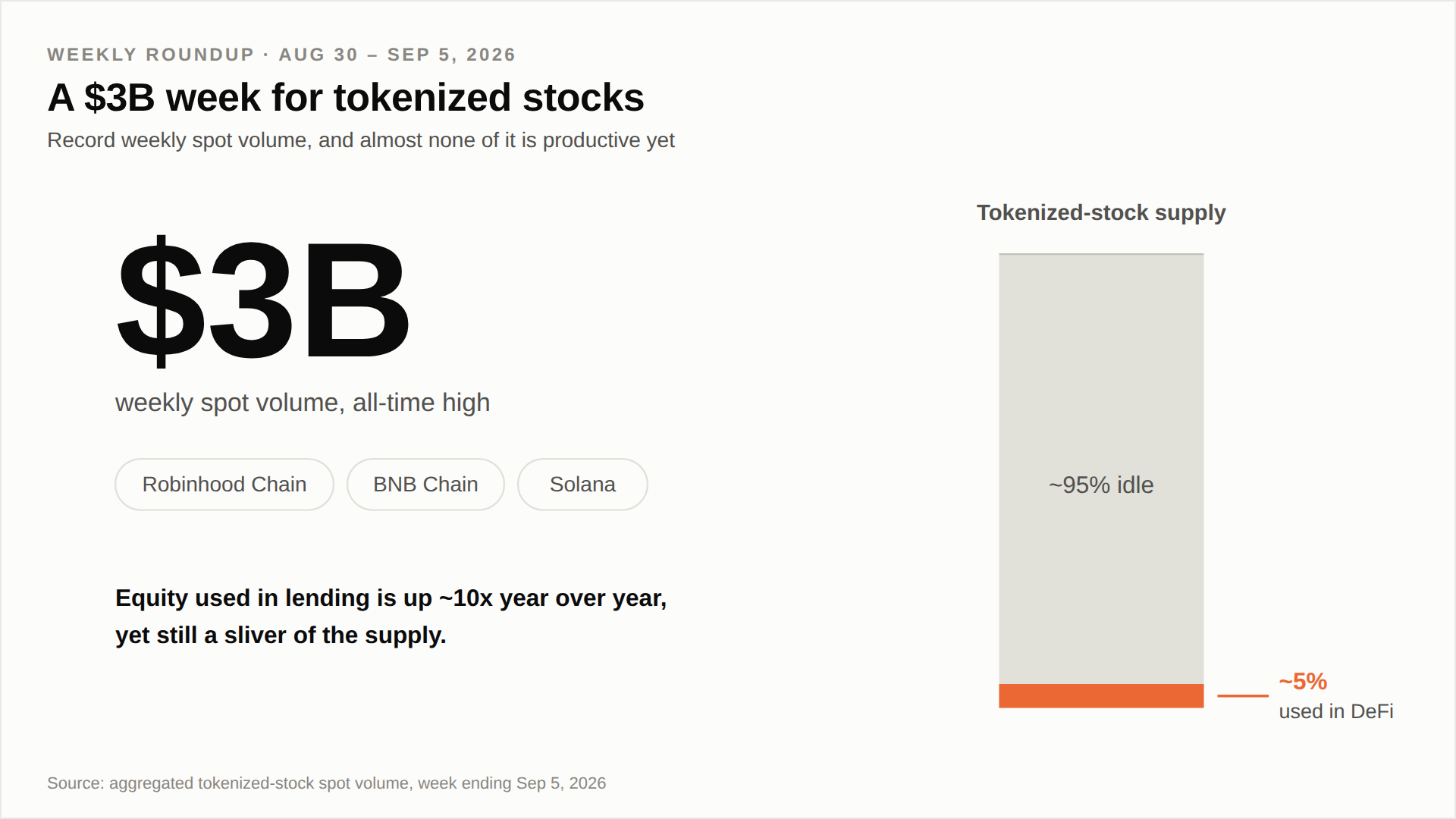
Weekly spot trading volume for tokenized stocks reached roughly $3 billion, an all-time high across Robinhood Chain, BNB Chain and Solana.

The supply side was active throughout the week too.

GoPro launched its tokenized equity through Backpack and Sunrise on September 1. The token generated roughly $8 million in day-one Raydium volume, with the liquidity pool generating around
65,000 in fees.

Then came SHEIN.

On September 2, SHEIN became available as $SHEINx through xStocks on Solana, on the same day the company listed on the Hong Kong Stock Exchange.

That detail is worth pausing on.

The tokenized version did not arrive months after the traditional listing. It arrived alongside it.

Backpack also launched four equity perpetuals tracking Micron, SanDisk, SPY and QQQ, while accepting real US shares as cross-collateral.

Mint, a Nasdaq-listed company trading under MIMI, announced on September 3 that it intends to tokenize its shares across Solana and Ethereum.

And earlier in the week, xStocks arrived in Kraken Wallet with more than 700 tokenized stocks and ETFs available for 24/7 trading.

Individually, these are separate products.

Together, they show the market moving toward a much broader inventory of onchain equities.

The number underneath the $3 billion matters more

There is another number worth watching.

Only around 5% of tokenized-stock supply is currently being used in DeFi, even as equity used in lending has grown roughly tenfold year over year.

That creates an interesting imbalance.

The market is getting increasingly good at putting stocks onchain.

It is still figuring out what to do with them afterward.

A tokenized stock sitting in a wallet is useful for trading and ownership. A tokenized stock accepted as collateral becomes useful for something else entirely.

It gives the holder access to liquidity without necessarily requiring the underlying asset to be sold.

That is where tokenization starts interacting with DeFi in a meaningful way.

The industry does not have a shortage of tokenized assets anymore.

It has a shortage of financial applications making those assets productive.

Lending is becoming the next battleground

That productive-collateral layer had a busy week.

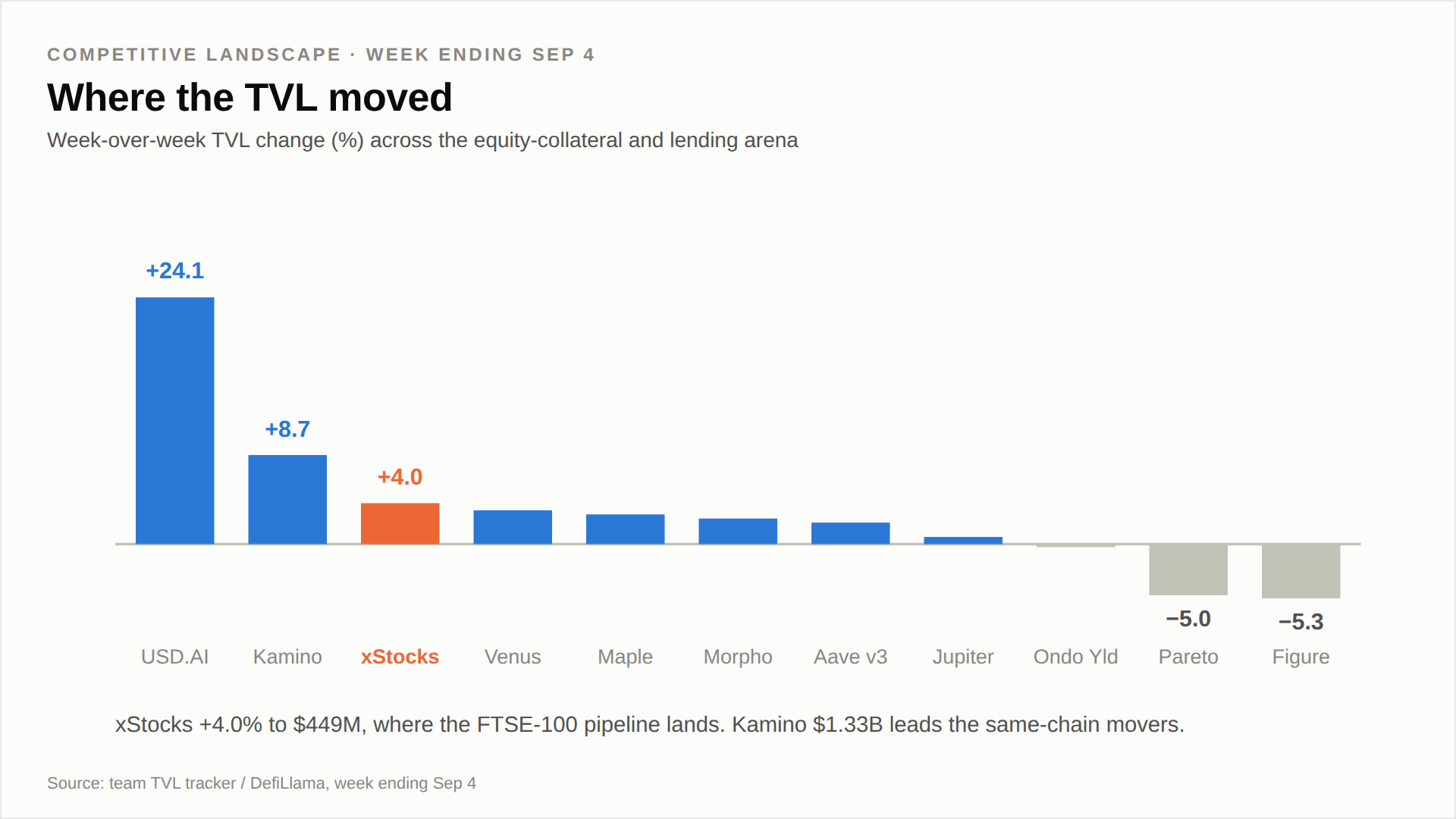
Coinbase Lend crossed $500 million in USDC deposits, with the lending product built on Morpho and Steakhouse.

On Solana, Kamino’s vaults became available inside Binance Wallet’s DeFi tab, bringing Solana-native lending products directly into a much larger distribution channel.

Securitize’s HINC fund was also accepted as collateral on Loopscale, adding another tokenized institutional asset to a lending environment. IMG_4269 These developments point toward a broader change in how collateral is being viewed.
Traditionally, DeFi collateral has been dominated by crypto-native assets.

The more tokenized securities enter lending markets, the more that definition starts to change.

A Treasury fund, equity or other traditional financial instrument does not need to stop being a real-world asset once it becomes a token. It becomes another potential primitive for onchain financial applications.

But this also raises the bar for risk management.

HINC’s proposed integration into Aave Horizon, for example, drew attention this week after analysis highlighted a historical four-session proxy loss of 10.87%, substantially above the proposed risk ceiling.

This is exactly why RWA lending is harder than simply adding another token to a lending market.

The underlying asset has its own liquidity, volatility, market structure and redemption mechanics.

All of those characteristics have to make sense inside a 24/7 onchain environment.

The week’s cautionary tale came from Cronos

The risk conversation was not theoretical this week.

On September 1, Tectonic, the main lending protocol on Cronos, was exploited for roughly $75 million.

Crypto.com’s Cronos chain responded by halting the entire network and rolling the chain back to blunt the damage.

A full chain rollback on a major network is an extraordinary step, and it will fuel decentralization debates for months. If a chain can be rewound to undo an exploit, what else can it be rewound for?

Worth noting on the other side of the ledger: Solana and Ethereum DeFi recorded no major exploit all week, the first clean week in a month.

Where your collateral lives matters.

Traditional yield is still setting the bar

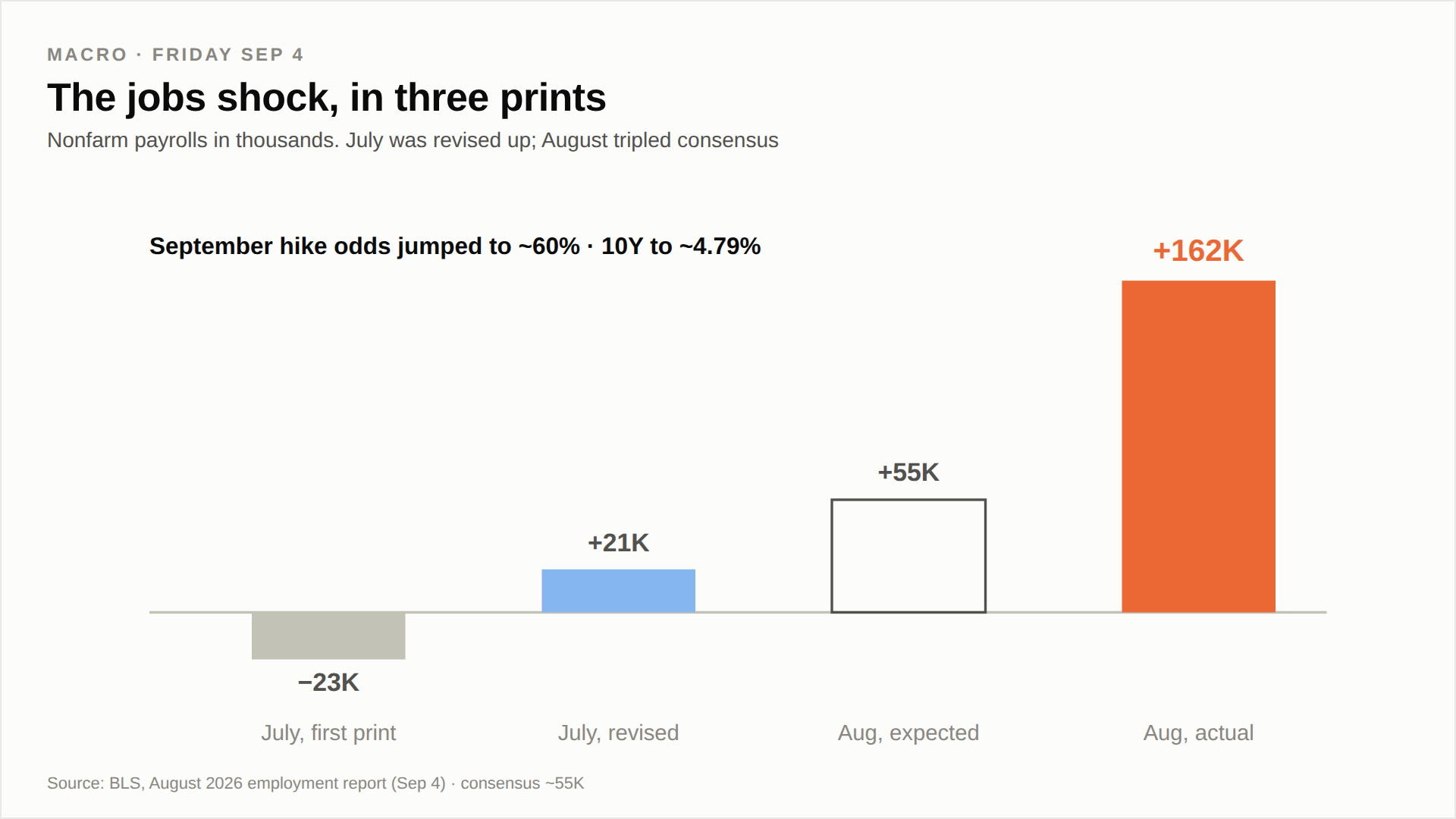
Friday’s jobs report added another variable. IMG_4267 The US economy added 162,000 jobs in August, significantly above the roughly 55,000 consensus estimate. Unemployment came in at 4.1%, while July’s payroll figure was revised up to +21,000 from the initially reported decline.
Markets immediately repriced expectations for Federal Reserve policy.

The probability of a September rate hike moved toward roughly 60%, the 10-year Treasury yield climbed toward 4.79%, and Bitcoin fell from around $81,300 to $78,600 within minutes.

For DeFi, the important part is not Bitcoin’s move.

It is the return available from traditional markets.

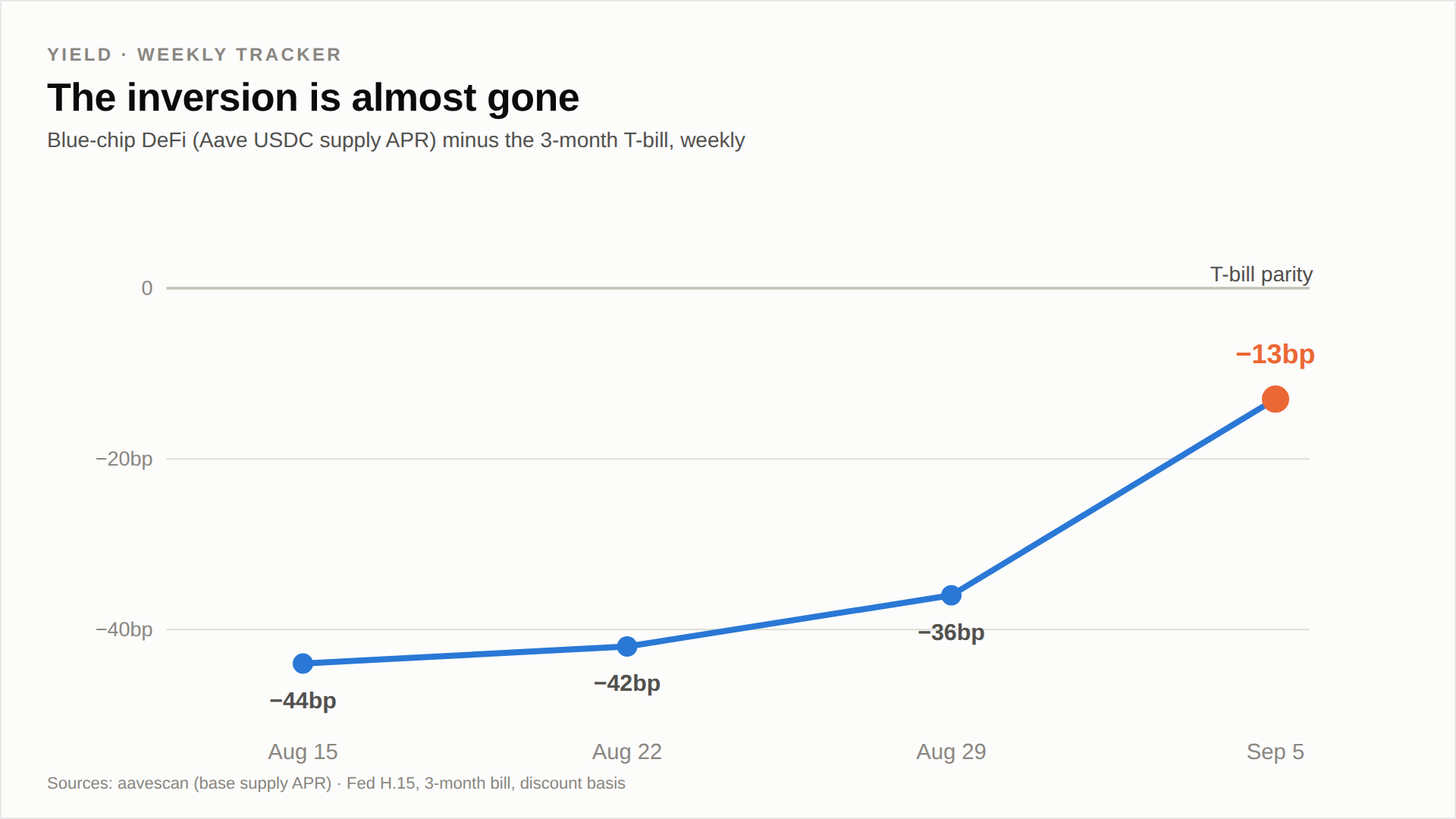
Three-month Treasury bills were around 3.75% at the end of the week. Aave’s USDC supply rate was around 3.62%, putting the two within roughly 13 basis points of each other.

That gap had been considerably wider the previous week. IMG_4266 The implication is simple.

Onchain yield is no longer competing only against other crypto yields.

It is competing against Treasuries, money-market products and other relatively low-risk financial instruments.

That makes the source of yield increasingly important.

A higher APY means little without understanding where the return comes from and what risks are being taken to generate it.

The flows rotated back to the majors

The institutional flows told their own story this week.

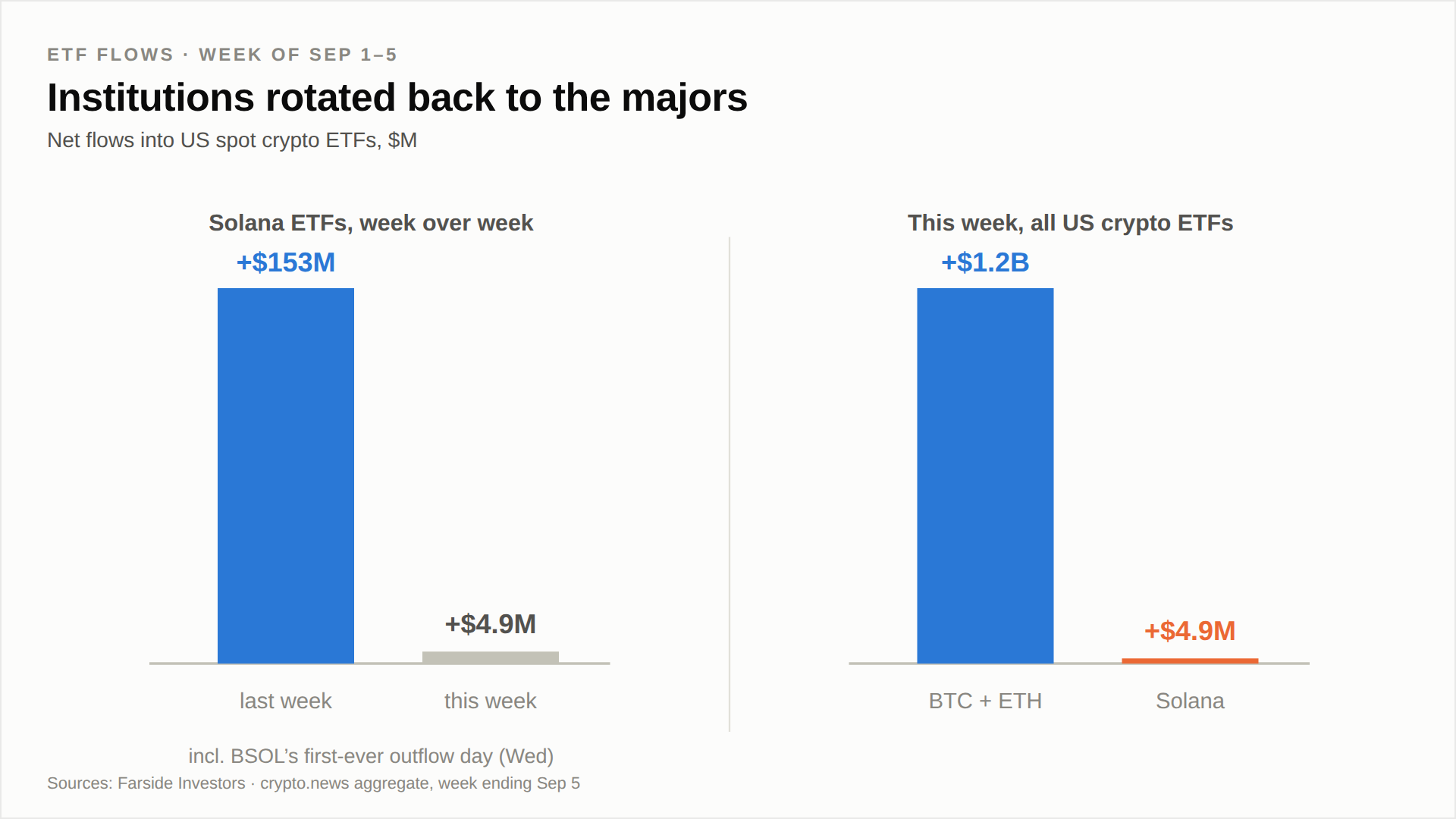
Bitcoin and Ethereum ETFs pulled in a combined

.2 billion.

US spot Solana ETFs, coming off their record

53 million week, took in roughly $5 million, while BSOL recorded its first-ever daily outflow on Wednesday.

One week does not make a trend, but the rotation was clear. After Solana’s strongest ETF stretch since launch, institutional demand moved back toward the majors as the macro picture repriced.

The treasury companies stayed active too.

Strategy ended a 10-week buying pause with 4,603 BTC for $369.7 million on August 31. BitMine added 53,501 ETH, lifting its holdings to 5.90 million ETH, roughly 4.9% of all ETH in existence.

Solana had a huge month underneath a relatively quiet week

Solana itself did not need another headline-grabbing rally this week.

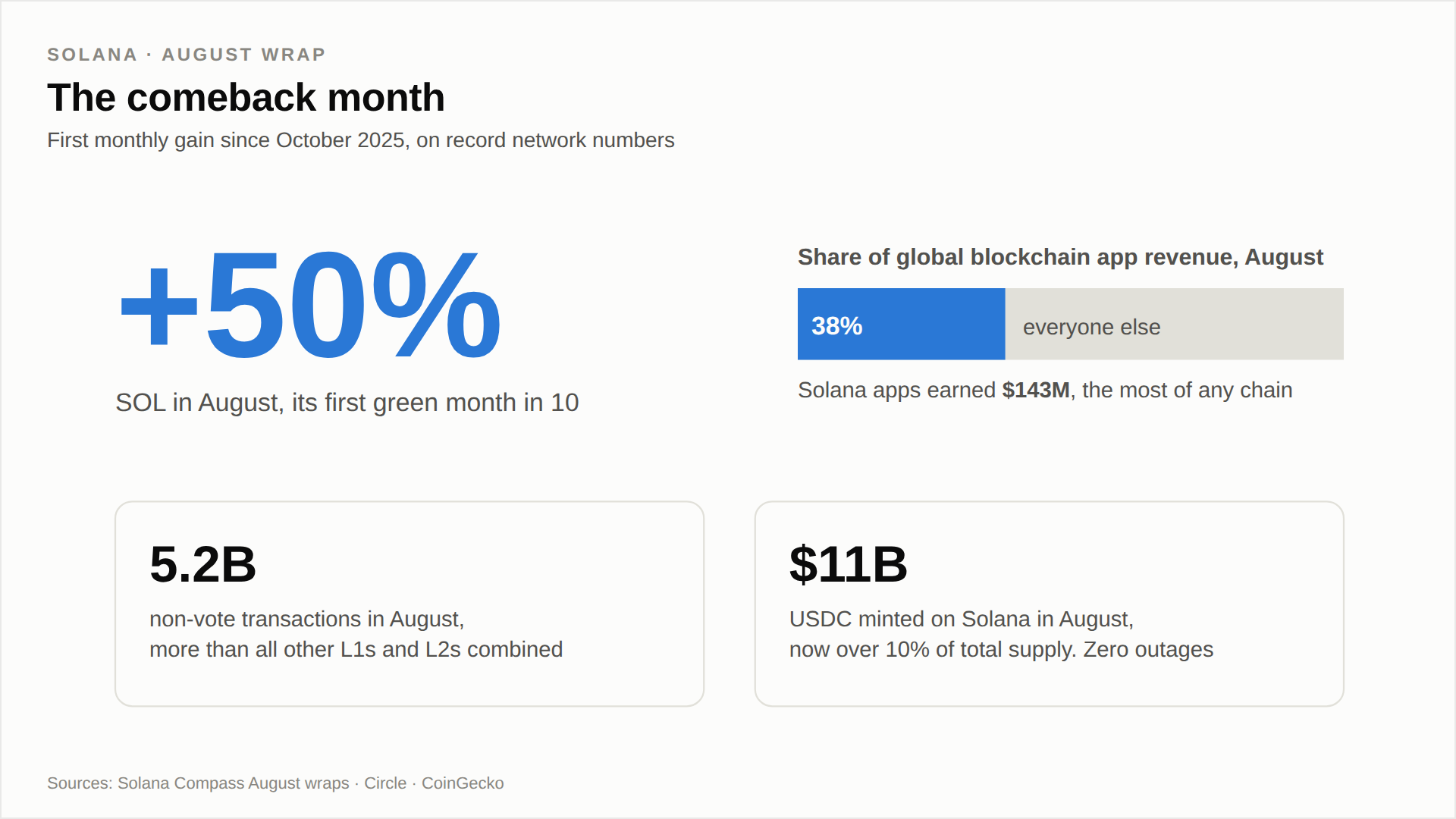
SOL closed August with its first monthly gain in ten months, up roughly 50%, and spent this week consolidating around

02–104 through a hawkish macro tape.

Flat through a week like this one is a strong tape.

The bigger story was what the network had already processed during August.

Solana recorded 5.2 billion non-vote transactions during the month, more than all other L1s and L2s combined.

Applications on the network generated around

43 million in revenue, giving Solana roughly 38% of global blockchain application revenue.

Circle also minted more than

1 billion in USDC on Solana during August, pushing the network above 10% of total USDC supply. IMG_4270 IMG_4263 Those numbers matter for RWA because financial markets need more than asset issuance.

They need settlement, stable liquidity, applications and users.

Solana is increasingly building all four.

There was a legal milestone too.

On September 1, a federal judge dismissed Solana Labs and the Solana Foundation from the Burwick class action, removing one less overhang on the ecosystem heading into a heavy September.

The infrastructure keeps getting upgraded

Solana also had a meaningful engineering week.

Transaction V1 activated on testnet on September 2, increasing the maximum transaction size to 4,096 bytes. Mainnet activation is scheduled for September 9.

Then on September 3, the first step of SIMD-0437’s rent reduction went live on mainnet. The five-stage process ultimately targets a 90% reduction in account storage costs.

Jupiter also launched Universal Deposit, allowing supported assets from Ethereum, Base, Arbitrum, Sui and other networks to be routed into native USDC on Solana for a flat $0.30 fee.

Meanwhile, Pyth crossed

0.4 million in ARR during August and expanded its 24/7 equity-index coverage. Bitwise became Solana’s fifth-largest validator with 1.27 million SOL staked.

These developments might look unrelated to tokenized stocks at first.

They are not.

A financial market operating onchain needs cheap transactions, reliable data, stable settlement assets and infrastructure capable of handling activity around the clock.

The more Solana develops those pieces, the more attractive the network becomes for applications sitting at the intersection of TradFi and DeFi.

The market is getting bigger. The utility layer is still catching up.

That is probably the clearest takeaway from this week’s developments.

The asset side is moving quickly.

More public equities are becoming tokenized. Tokenized-stock trading is reaching record volumes. Major exchanges are preparing infrastructure for blockchain-based securities. Banks are building stablecoin rails.

Venture capital is moving in the same direction too. Félix raised

00 million led by a16z, while Cari raised $32.5 million for bank-deposit tokens this week alone.

But the percentage of tokenized equities actually being used inside DeFi remains small.

That creates a clear gap between ownership and utility.

And it is becoming harder to ignore.

The next stage of the RWA market will not be defined by how many assets get tokenized.

It will be defined by what people are able to do once those assets are onchain.

Hold them.

Trade them.

Use them as collateral.

Borrow against them.

Generate yield from them.

Move them between financial applications.

That is where tokenization starts becoming more than a new way to represent an existing asset.

It becomes a new way to use it.

Solana is building the rails for productive assets

If the RWA market is becoming more focused on what happens after tokenization, Solana is increasingly becoming one of the places where those ideas are being tested in practice.

The August numbers covered above, 5.2 billion transactions,

43 million in application revenue and
1 billion in freshly minted USDC, are exactly the foundation a productive-asset market needs.

Financial markets need more than an asset layer.

They need liquidity.

They need settlement.

They need reliable market data.

They need applications capable of handling large amounts of activity.

And they need all of those pieces to work together without making every transaction expensive or complicated.

Solana is steadily building toward that environment. The upgrades shipping this month, from Transaction V1 to the rent reduction to Jupiter’s Universal Deposit, all push in the same direction: more complex transactions, lower operating costs and easier movement of capital.

The equity market is starting to look different onchain

The tokenized-stock activity this week makes the direction even clearer.

SHEIN arrived on Solana as $SHEINx on the same day it listed on the Hong Kong Stock Exchange. GoPro launched a tokenized equity through Backpack and Sunrise. Backpack introduced equity perpetuals alongside real US shares as cross-collateral.

These are different products serving different use cases, but they are all pushing traditional equity exposure into a financial environment where assets are programmable.

That changes the possibilities around ownership.

A traditional stock is generally bought, held and eventually sold.

A tokenized stock still represents the underlying equity, but the digital format creates more opportunities for it to interact with other financial applications.

It is this transition from asset ownership to financial utility that matters most for Spout.

This is where Spout comes in

The market is getting increasingly good at bringing equities onchain.

Spout is focused on what happens next.

We are building around tokenized equities on Solana and the financial utility they create once they are onchain.

The thesis is straightforward.

If someone owns a tokenized equity, the value of that asset should not necessarily remain idle until the owner decides to sell.

It can serve as collateral.

That collateral can provide access to liquidity.

And the underlying financial exposure can participate in strategies designed to generate yield.

This is a different way of thinking about tokenized stocks.

The objective is not simply to recreate a brokerage account on a blockchain.

It is to give tokenized equity holders more ways to use the financial value they already own.

That becomes increasingly relevant as the supply of tokenized equities expands.

The LSE is working toward tokenized exposure to major UK-listed companies. ICE is preparing infrastructure for public tokenized securities. More individual equities are appearing onchain every week.

The pool of assets available for productive financial applications is getting larger.

At the same time, only around 5% of tokenized-stock supply is reportedly being used in DeFi.

That is the gap Spout is interested in.

Turning equity exposure into access to capital

One of the most important differences between holding an asset and using it is liquidity.

Selling an asset gives you liquidity, but it also means giving up the position.

Borrowing against it creates another option.

A tokenized equity holder could retain exposure to the underlying asset while accessing stablecoin liquidity against its value.

This is the role borrowing plays in the Spout model.

Instead of forcing a user to sell an equity position to access capital, the asset becomes part of the financing structure.

For someone holding a long-term position, this creates a fundamentally different choice.

You do not have to think only in terms of hold or sell.

There is another possibility: hold and borrow.

That does not remove risk. Borrowing against volatile assets introduces liquidation risk, market risk and collateral requirements.

Which is why the quality of the collateral system matters as much as the ability to borrow.

And this week’s macro shift makes the option more relevant, not less. With markets pricing a roughly 60% chance the Fed raises rates in ten days, the cost of every interest-bearing borrowing alternative is heading up.

A structural 0% borrow does not reprice with the curve.

Yield needs a source

The other side of the Spout model is yield.

This week’s DeFi market made one thing clear: yield is becoming harder to evaluate by the headline APY alone.

Three-month Treasury bills were around 3.75% at the end of the week, while Aave USDC supply was around 3.62%. Other onchain products offered higher returns, but those returns came with different forms of risk.

As traditional rates remain competitive, simply offering a high number is not enough.

Users need to understand what generates the return.

Spout approaches this through strategies tied to the underlying financial market, including covered-call structures around tokenized equities.

The distinction matters.

The objective is not to manufacture an attractive APY through temporary incentives.

It is to connect yield generation to an actual financial activity.

That makes the underlying equity exposure important rather than incidental.

The risk conversation gets more important as the market grows

This week’s HINC discussions are a good example of why productive RWAs require more than attractive assets.

Once a tokenized asset becomes collateral, its historical price behavior, liquidity and redemption structure suddenly matter to an entire lending market.

The same applies to tokenized equities.

A stock market operates according to traditional market hours.

Blockchain markets operate 24/7.

An equity can experience a major move while onchain markets remain active, even when the underlying exchange is closed.

That creates questions around pricing, liquidation and oracle design.

Spout’s approach therefore has to account for the underlying market rather than treating tokenized equities like another crypto token.

The collateral is connected to a real-world asset.

The risk controls need to respect that reality.

This week’s Tectonic exploit, and the chain rollback that followed, is the other half of the same lesson.

Infrastructure quality is not a detail.

It is the product.

What this means for Spout users

For Spout users, the biggest change is the number of options emerging around tokenized equity ownership.

The market is moving toward a point where owning an onchain representation of an equity does not have to mean sitting on it and waiting for the price to move.

Users are gaining access to a broader financial stack around those assets.

With Spout, the focus is on two key pieces: access to liquidity through borrowing and the ability to earn from strategies built around tokenized equities.

That creates a different experience from simply holding a tokenized stock.

An equity position becomes collateral.

Collateral becomes borrowing power.

And the financial exposure itself becomes part of a yield strategy.

For users, this means the value of tokenized equities extends beyond price appreciation.

There is a potential financial use for the asset while it remains in the user’s portfolio.

The timing is becoming more interesting

A lot is happening around this thesis at the same time.

Traditional exchanges are preparing tokenized securities infrastructure.

Regulators are updating the rules around blockchain-based ownership records.

Banks are working on stablecoin settlement.

Tokenized-stock volumes are reaching record levels.

DeFi is testing traditional assets as collateral.

And Solana is continuing to expand the infrastructure underneath these markets.

Yet the market still has a relatively small amount of productive activity compared with the amount of value being tokenized.

That is the part worth watching.

The next wave of RWA growth does not need to come from creating another tokenized stock.

It can come from making the existing ones more useful.

For Spout, that means building the financial layer around tokenized equities rather than stopping at tokenization itself.

The asset is only the starting point.

The real opportunity is what happens after it arrives onchain.

What to watch next

A lot of what happened this week points toward an even busier stretch ahead.

Solana has major network upgrades coming. Regulators are moving closer to decisions around crypto market structure and 24/7 trading. The Fed has another inflation print and policy meeting ahead. And Circle’s Arc is set to open another chapter in stablecoin infrastructure.

The key dates ahead:

  • September 9: Transaction V1 activates on Solana mainnet
  • September 10–11: CPI, the last inflation print before the Fed meets
  • September 14: SEC Chair Atkins keynotes Solana Summit DC
  • September 15: CLARITY Act cloture vote in the Senate
  • September 15–16: FOMC meeting, with hike odds near 60%
  • September 16: Circle’s Arc mainnet goes public
  • September 17: SEC roundtable on 24/7 trading
  • September 28: Alpenglow activation begins on Solana

The assets are moving onchain. The infrastructure is catching up. The rules are starting to take shape.

The next few weeks should tell us a lot about where the market goes from here.

See you next week.